

























































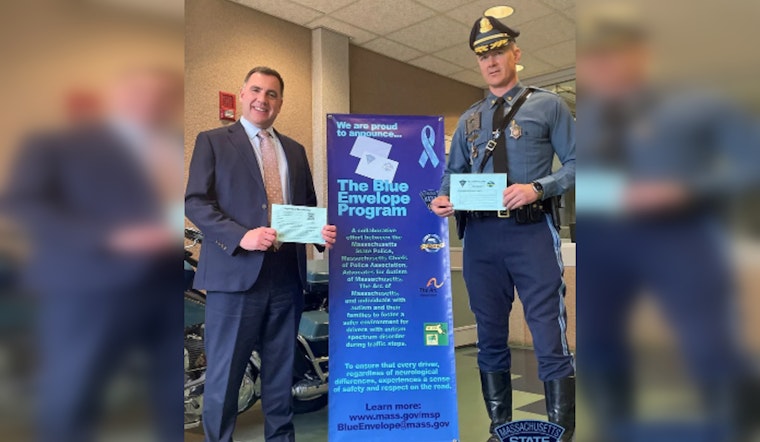
Massachusetts drivers with autism can now rely on a new tool for smoother interactions with the police. The Bay State has rolled out its Blue Envelope Program, which provides distinct blue envelopes for drivers on the autism spectrum to store and present their driving documents in an official capacity during traffic stops. This innovative initiative was introduced to mark the observance of Autism Acceptance Month.
The Blue Envelope Program is a collaboration between local law enforcement, including the Massachusetts State Police and the Massachusetts Chiefs of Police Association, as well as advocacy groups like Advocates for Autism of Massachusetts (AFAM) and The Arc of Massachusetts. Announced by the Healey-Driscoll Administration, the envelopes contain a driver's license, registration, and crucial contact information. Alongside the standard documents, the blue envelopes are imprinted with critical instructions that cue officers into the driver's condition and provide communication guidelines tailored to navigate the interaction more successfully.
Massachusetts Governor Maura Healey highlighted the state's commitment to inclusivity in a statement: "In honor of Autism Acceptance Month, the Blue Envelope Program reflects our deep commitment to supporting programs that strengthen inclusivity and support law enforcement's ability to more effectively meet the needs of every community member."
Furthermore, the blue envelopes are designed to demystify and de-escalate potential traffic stop tension—the presence of an envelope cluing in officers to adapt their approach and easing anxiety for the driver. The program aspires to bolster preparedness for drivers with autism, ensuring that they keep their important documents in the envelope and understand its presentation protocol during a stop. The envelopes should soon be readily available at all Massachusetts State Police Barracks and locality police departments.
"The most important qualities a police officer must possess are empathy and understanding. Those who wear the badge never stand so tall as when they conduct themselves in a manner that eases fear, anxiety, and confusion of a person in difficult situation," Colonel John J. Mawn Jr., Interim Superintendent of the Massachusetts State Police, told the publication. Echoing this sentiment, parents like Ilyse Levine-Kanji, an AFAM Executive Committee member, hail the program as a "game changer" for the safety and well-being of individuals with autism.





