

























































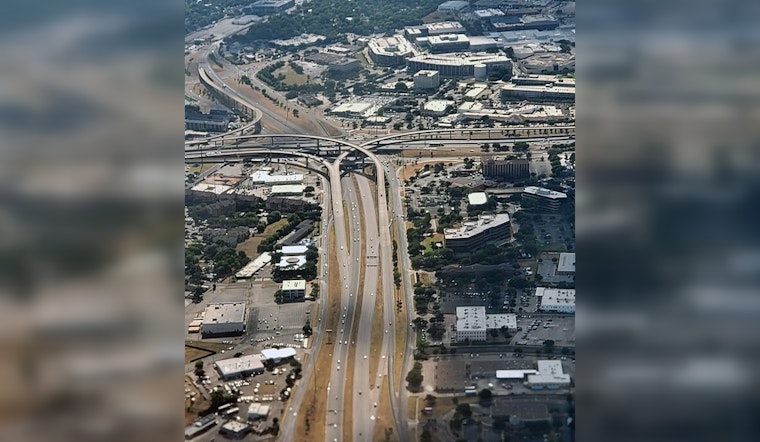
As Austin braces for a major makeover of its I-35 artery, the city's residents and business owners find themselves at a crossroads. In arguably the largest expansion since its 1962 debut, the I-35 Capital Express Central project is plowing forward, despite fears of displacement and environmental repercussions, reports KXAN.
With TxDOT's plans to sink the main lanes and erect new "managed lanes," more than a hundred homes and businesses are slated for demolition. The immense $4.5 billion project targets 54 acres of land, intending to untangle the notorious congestion but at a high cost to the community, according to KUT. In a statement obtained byhttps://www.kut.org/transportation/2024-02-21/your-ultimate-guide-to-the-i-35-expansion-through-central-austin KUT, TxDOT insists on reducing lane widths from 12 to 11 feet – a move they say will limit additional land appropriation.
Families and local enterprises are caught in the riptide of progress, some facing the stark reality of upheaval. Kelsey Thompson, KXAN investigative fellow sheds light on the disquietude of those impacted, painting a picture of growth shadowed by uncertainty. The expansion, named I-35 CapEx Central, not only reshapes the landscape but also the lives woven into the fabric of Central Austin.
Despite the forward thrust of construction, the schematics for I-35 from Ben White Boulevard to U.S. 290 East remain fluid, causing ambiguity for those directly in the path. Components like the anticipated sinking of the main lanes by 30-40 feet—transforming parts of the highway into an "I-35 tunnel" through downtown—hinge on financial participation by Austin and the University of Texas, explains KUT. The price tag for the city could soar close to $900 million, not including maintenance.
A fluctuation in travel behavior is a potential byproduct of these infrastructure adjustments. A Texas A&M University study cited by KUT found a minor reduction in speed when lane widths are narrowed but also highlighted an uptick in injury-causing or fatal crashes. Nevertheless, the promise of expanded east-west vehicle bridges, pedestrian spans, and over 20 miles of 'shared-use paths' continue to propel the project forward. In a city grappling with its evolving identity, the I-35 expansion is a road not just to greater connectivity but also to deep-seated community concerns.





