

























































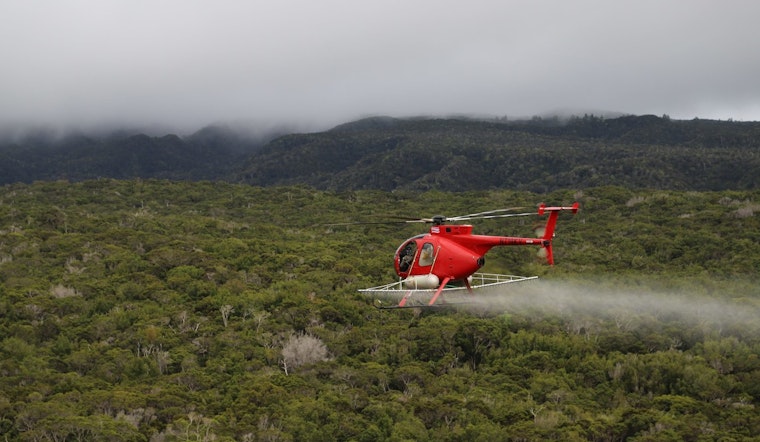
Hawaii's conservationists have taken to the skies in a concerted effort to protect their feathered natives from mosquito-driven avian malaria, employing tactics straight out of an entomologist's strategic playbook. Specifically on Kaua‘i, and soon on Maui, helicopters are swooping in to deliver a bacterial payload designed to take down mosquito larvae before they can rise up to threaten endangered bird species. The bacterial weapon of choice, Bacillus Thuringiensis Israelensis (BTi), has been deemed by experts as harmless to pretty much every other living being on the islands.
According to a DLNR press release, BTi holds a stellar reputation worldwide for its efficacy in public health and mosquito nuisance control, approved by the Environmental Protection Agency and available for purchase by the general public. However, in this particular mission, trucks and handheld sprayers are no match for the pockets of standing water inhabiting Hawaii's lush rainforests, thus, the choice of an airborne approach was necessary.
Dr. Lisa 'Cali' Crampton, project manager for the Kaua‘i Forest Bird Recovery Project (KFBRP), underscored the selective lethality of BTi, "It won’t affect any vertebrates like fish or birds, or your dog or your pig, or even you if you happen to drink water that this bacterium is found in," she told DLNR. Crampton's team has already observed promising results from their initial phase of BTi use, witnessing mosquito larvae in treated water meeting their maker at significantly higher rates than in untreated samples.
The continuity of this ecological intervention is critical, as Crampton pointed out on DLNR about the relentless nature of mosquito populations, "once you take the foot off the brake, the mosquito train will roll on. So, we have to keep applying that brake." And apply they shall, with scheduled applications starting on Maui after the first day of the new year, while Kaua‘i initiates its second phase of the BTi campaign.
But BTi is not the lone ranger in this battle against bug-borne illness. The Incompatible Insect Technique (IIT), currently in use on Maui, is expected to complement BTi efforts on Kaua‘i the following year. The dual-pronged approach represents a broader dilemma in the conservation community on how best to allocate limited resources to mitigate pressing environmental crises, as revealed by Crampton in a DLNR interview. “I think the tricky question in conservation right now is that there is such a crisis and there is such a demand on financial and other resources, we’re all trying to figure out the best way to deal with our huge problems,” she reflected on DLNR.
It's a multifaceted strategy, geared towards maintaining the melodic chirps and vibrant plumage of Hawaii's endemic birds, which, as Crampton emphasized, offer invaluable cultural and economic benefits. "It is to our benefit to do everything humanly possible to protect these birds," she concluded on DLNR, underscoring the importance of the concerted effort against such a seemingly small, yet immensely destructive adversary as the malaria-carrying mosquito.





