

























































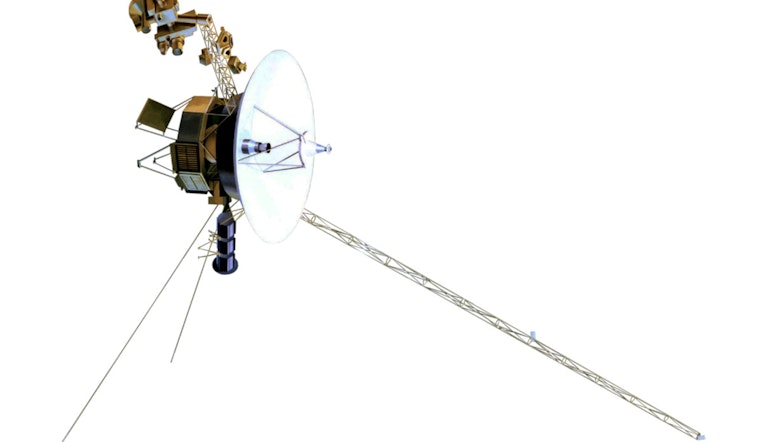
NASA's Voyager 2 spacecraft has officially shut down its MIT Plasma Science Experiment (PLS) after completing a 47-year mission. Initially designed for a four-year lifespan, the Voyagers have exceeded their intended duration since their launch in the 1970s. The PLS has been essential for studying charged particles in various cosmic environments, contributing to the understanding of the outer planets and regions beyond the sun's influence.
Having sent its final communication from a distance of 12.7 billion miles last Thursday, the PLS was powered down to conserve the probe's diminishing energy reserves. In a statement to MIT News, Principal Investigator John Richardson discussed key findings from the instrument, including the discovery of the Io torus at Jupiter and insights into the magnetospheres of other planets. The instrument also marked the termination shock, the point where the solar wind transitions from supersonic to subsonic speeds.
MIT has been instrumental in developing the plasma sensors, with significant contributions from Herbert Bridge and Alan Lazarus. According to Richardson, the sensors utilize Faraday cup detectors to measure particle currents. Despite facing technological challenges and the effects of time, the teams behind the mission have successfully maintained the functionality of the probes, addressing issues such as the memory glitch experienced by Voyager 1 in November 2023, as per MIT News.
As the Voyagers gradually lose their scientific instruments, they still have ongoing objectives. Richardson informed MIT News that the spacecraft will continue to transmit data on galactic cosmic rays, magnetic fields, and plasma waves. However, the plutonium power source diminishes at a rate of about four watts per year, challenging scientists to keep the probes' systems operational until the possible end of their mission in the mid-2030s. As they travel deeper into space, the spacecraft are expected to pass by neighboring stars in approximately 30,000 years, serving as enduring messengers of humanity long after Earth has ceased to exist.
A personal touch was added to these scientific endeavors by Robert Butler, the chief engineer of the Plasma Instrument, who engraved the names of MIT engineers along with New Hampshire's state motto, "Live Free or Die," He engraved a piece of human history that, according to MIT News, may endure on an interstellar scale. A spare version of the instrument, along with its inscriptions, can be viewed at the MIT Museum.


