

























































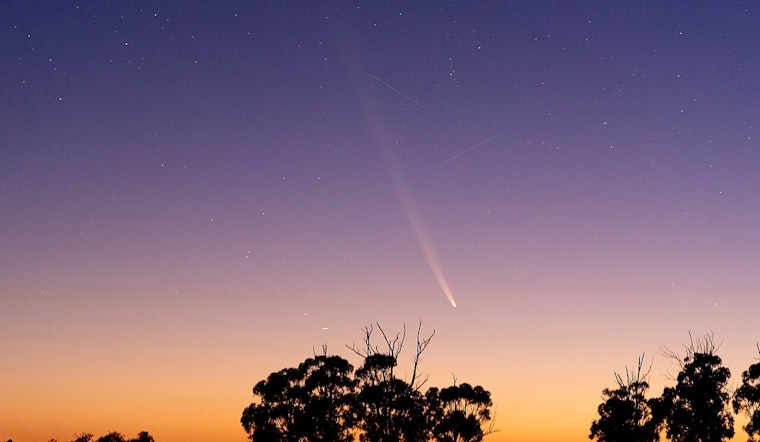
The celestial event of the season is happening over Central Texas, and it's an astronomical rarity that's got everyone talking. The comet known as C/2023 A3, also dubbed Tsuchinshan-ATLAS, is gracing the night skies and offering a spectacle not to be repeated for another 80,000 years. With skies anticipated to remain clear across the region up until October 18th, from Monday through Friday, there are prime opportunities for locals and sky enthusiasts to catch a glimpse of this interstellar visitor.
As reported by KVUE, the best times to view the comet are just after sunset, particularly between 1 and 2 hours when the twilight fades into a darker canvas. For those equipped with binoculars, or even with the naked eye, the comet will appear in the western sky, "about 2½ fists to the upper right of Venus." As we proceed through the month, however, the comet's brilliance will diminish, and it will ascend higher, becoming tougher to spot without the help of telescopes.
Over the weekend, residents from various parts of Central Texas — including Dripping Springs, Liberty Hill, and Lago Vista — managed to photograph the rare comet passing overhead. Through the lenses of neighborhood stargazers, the cosmic entity has been immortalized in snapshots that have swiftly proliferated on social media platforms. "KXAN viewers in Dripping Springs, Liberty Hill, south Austin, Lago Vista, Leander and Salado shared images capturing the phenomenon Saturday and Sunday evenings," according to KXAN.
Scientifically speaking, comets are often described as "frozen leftovers" from the formation of our solar system, consisting of dust, rock, and ice. These ancient entities typically originate from distant fields of cosmic debris, such as the Kuiper Belt or, as is the case with C/2023 A3 Tsuchinshan-ATLAS, the remote Oort Cloud. As these wanderers approach the sun, they heat up and begin outgassing, leaving behind a distinctive tail that is often visible from Earth.
While it is an ephemeral visit, the journey of C/2023 A3 Tsuchinshan-ATLAS across our skies offers more than just a visual treat; it provides a palpable connection to the absolute vastness of space and time. For detailed insights into this and similar cosmic phenomena, NASA's blog stands as the beacon for those who seek deeper knowledge about our universe and the billions of comets that dance around our sun.





