

























































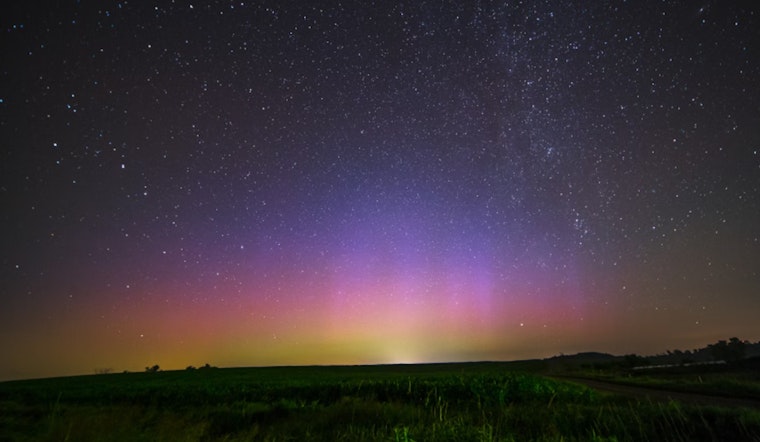
The skies above St. Louis could amaze residents with the rare sight of the northern lights this Thursday. A geomagnetic storm, triggered by solar activity, is expected to extend the auroral zone much farther south than usual. The National Oceanic and Atmospheric Administration's Space Weather Prediction Center states that St. Louis is among the northern cities that might experience "spectacular displays" of aurora borealis, according to KSDK.
Usually only visible in polar regions, the potential sighting of the northern lights in the evening sky has generated excitement, but it has also raised concerns about the impact of a geomagnetic storm on the power grid. Following a series of moderate to strong solar flares from a large sunspot cluster that reached Earth at nearly 1.5 million miles per hour at 11:15 a.m. EDT, the center issued a Strong (G3) Geomagnetic Storm Warning on Thursday morning, according to a report by Fox 2 Now.
The northern lights, or Aurora Borealis, occur when particles from solar flares collide with molecules in our atmosphere. Best seen away from urban light pollution, this colorful phenomenon is expected to be visible in St. Louis. The National Oceanic and Atmospheric Administration urges viewers to find locations with clear, dark skies for the best experience. Their projections include parts of Missouri and Illinois within the visibility range of the northern lights.
The rare event is linked to a "fast coronal mass ejection" that erupted from the sun on Tuesday, with the effects likely to reach Earth the same night, as mentioned in a statement obtained by St. Louis Post-Dispatch. National Oceanic and Atmospheric Administration has issued a "severe" geomagnetic storm watch for Thursday and Friday, indicating that such watches at this level are "very rare". They also said, "The aurora may become visible over much of the northern half of the country, and maybe as far south as Alabama to Northern California."




