

























































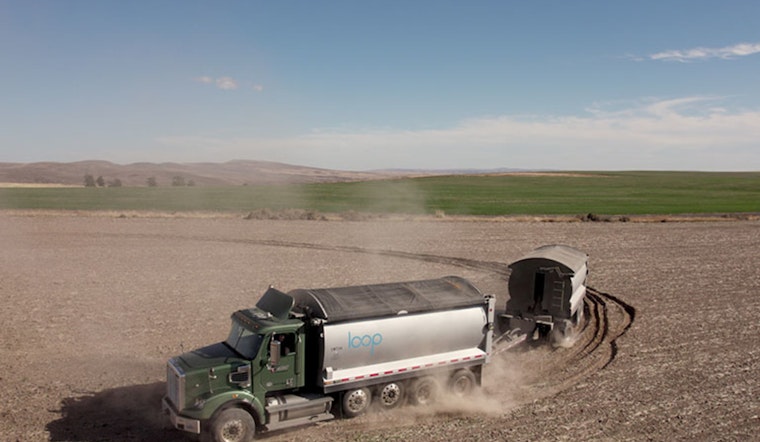
In a forward-thinking approach to agriculture, King County's Wastewater Treatment Division is turning heads with its Loop biosolids program. Farmers across Central Washington are hailing the initiative for boosting crop yields and fortifying their soil against drought. According to King County, these biosolids not only outperform traditional fertilizers but do so in an eco-friendly manner.
Loop biosolids, a product of King County's wastewater treatment process, have been shown in studies to improve crop production by up to an astounding 40%. The program dates back to 1992 and remains focused on its mission to repurpose recovered resources. Kamuron Gurol, director of the King County Wastewater Treatment Division, highlighted the multiple decades of positive impact on agriculture and land restoration, stating, "By capturing and beneficially using a valuable resource, we are leading the way toward a more sustainable and climate-resilient future," as stated by King County.
Field experiences support these claims. Farmer Douglas Poole, a member of the Boulder Park Inc. consortium, credits biosolids with significantly improved crop yields and soil conditions, saying in a statement made by King County, "If a field is starting to produce, it’s because it’s had biosolids." Like many others in the region, Poole's operation has seen a notable transformation since the introduction of Loop to its soil management practices.
With over 40 facilities contributing biosolids to the beneficial use program, King County ensures that Loop meets rigorous federal and state regulations. At the same time, they are actively studying the presence of per- and polyfluoroalkyl substances, or PFAS, to reduce possible contaminations.
The advantages of using Loop extend far beyond improved crop yields. The use of these biosolids has been instrumental in carbon sequestration, keeping an equivalent of about 9,000 cars worth of emissions off the road annually. Furthermore, enhancements to soil moisture retention contribute to water quality protection, mitigating problematic runoff and even algae blooms, which, as per King County, is increasingly vital for drought-stricken Central Washington farmers.




