

























































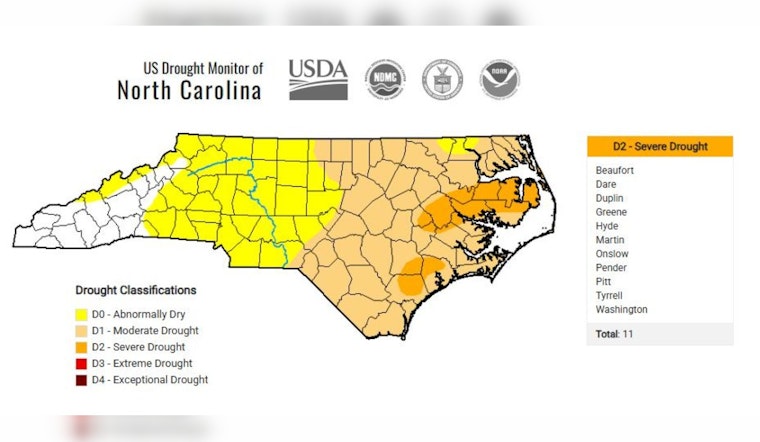
Severe drought conditions have triggered a serious alert for 11 counties in eastern North Carolina, as per the recent advisory from the state's Drought Management Advisory Council (DMAC). Among affected areas are Beaufort, Dare, Duplin, Greene, Hyde, Martin, Onslow, Pender, Pitt, Tyrrell, and Washington counties. These regions have been designated as suffering from severe drought, also referred to as D2.
Furthermore, the DMAC has categorized an additional 42 counties as experiencing moderate drought, or D1, marking an uptick in drought conditions across North Carolina. Originating from a dry October followed by a warm November, the persistent lack of precipitation has left these districts parched. Klaus Albertin, chair of the DMAC, conveyed concerns, stating “We have had a number of rain events, but the total monthly precipitation for many areas in the state has been below average in October, November and December. While some areas received four to 4 to 6 inches of snowfall last week, the water equivalence of snow is much less than rainfall, so the end effect was less than an inch of moisture,” as noted by the NC Dept of Environmental Quality.
Despite the challenging climate conditions, water systems have not been fully strained due to reduced seasonal demand and dormant vegetation. However, residents in areas severely affected by drought are urged to follow their local water utilities' Water Shortage Response recommendations and conserve water as a precaution.
Looking ahead, forecasts aren't particularly encouraging with expectations of a dry winter stretching ahead, largely attributed to the La Niña phenomenon. Albertin signaled concern for the coming months, informed by a pattern that could presage prolonged aridity. The DMAC, comprising drought experts hailing from government agencies across North Carolina, Virginia, and South Carolina, convenes weekly to deliberate and submit their drought condition assessments to authorities including the National Oceanic and Atmospheric Administration (NOAA) and National Drought Mitigation Center, ensuring that the U.S. Drought Monitor map reflects their latest insights, as per the NC Dept of Environmental Quality.
For those keen to stay updated on the unfolding situation, DMAC's drought map is refreshed each Thursday, incorporating data gathered through the previous Tuesday. The next update, expected on Thursday, January 23, will hopefully provide further clarity on the state's evolving drought status. Details can be accessed through North Carolina’s drought map, offering valuable information for residents and policymakers alike.





