

























































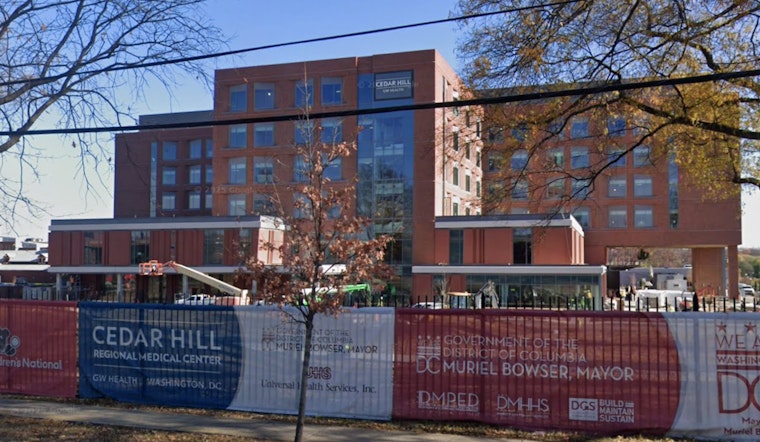
D.C.'s long-awaited Cedar Hill Regional Medical Center GW Health opened its doors, fulfilling Mayor Muriel Bowser's commitment to create a full-service hospital for residents on the eastern side of the Anacostia River. Bowser, alongside leaders from Universal Health Services and local healthcare officials, marked the occasion with a ribbon-cutting ceremony yesterday. According to a press release by the District's government, patients will be welcomed starting April 15 at 12:01 am.
The new facility, a public-private partnership project valued at $434.4 million, spans 406,000 square feet on the St. Elizabeths East campus in Ward 8. The Cedar Hill hospital includes 136 beds, expandable to 184, featuring a 54-bay emergency department—30 bays for adults and 24 for children, trauma care, and a host of other healthcare services. Dr. Anthony B. Coleman, CEO of Cedar Hill Regional Medical Center, emphasized the strategic importance of the location in Wards 7 and 8, areas historically underserved in terms of healthcare access.
This healthcare initiative comes as part of broader efforts to improve the medical infrastructure in the D.C. area. Cedar Hill will be integrated with the George Washington University Hospital and two forthcoming health centers in Wards 7 and 8, bolstered by Universal Health Services' $75 million commitment to health infrastructure. The company also plans to open a $22 million, 14-bed freestanding emergency department on the Fletcher Johnson Campus in Ward 7, which is slated for launch in late 2027.
"This is a monumental day for Universal Health Services, DC Government, and most importantly, the residents of this community and across the District who will now have access to high-quality care at this brand-new hospital," Marc D. Miller, President and CEO of Universal Health Services, said in a statement obtained by the District's government, reflective of the shared vision for health services expansion. In the same vein, GW Medical Faculty Associates aims to provide exceptional care, and Children's National Hospital will oversee the pediatric emergency department and the Level II NICU at Cedar Hill.
The project not only advances health care but also economic and community development. More than 500 District residents contributed to the construction, including 321 new hires from Wards 5 (98), 7 (102), and 8 (121). These efforts surpassed the 35% Certified Business Enterprise participation goal, directing $42 million to CBEs located in these wards. With the opening of Cedar Hill Regional Medical Center GW Health, the area sees a landmark moment for both the provision of health services and local economic empowerment.




