

























































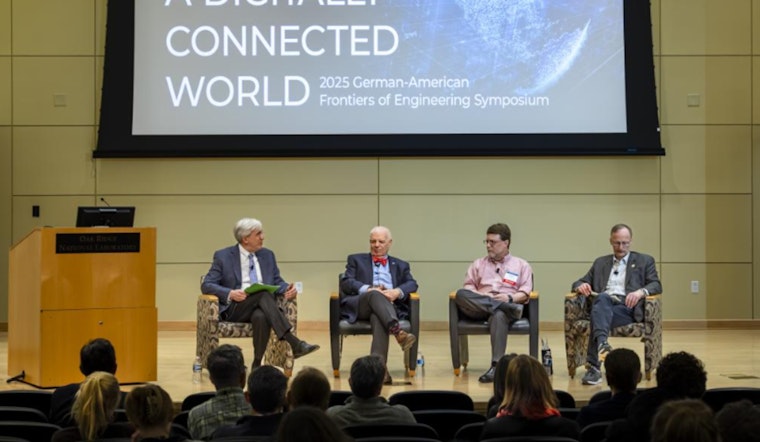
When the Department of Energy's Oak Ridge National Laboratory recently played host to the German-American Frontiers of Engineering Symposium, it wasn't just about showcasing the latest advances in technology, it was also about strengthening international ties. The four-day event in March, featuring sixty early-career researchers from the U.S. and Germany, centered on the theme "A Digitally Connected World." The gathering, alternating between German and U.S. soil each year, is designed to forge collaborative research networks, according to an article from the Oak Ridge National Laboratory.
In what seems like a nod to the serendipity of past research methods, ORNL Director Stephen Streiffer reminisced, "I mourned the death of library card catalogs because there was that chance, as you were thumbing through the cards, that you’d find something really cool that you’d never thought of before." The symposium seemed to echo a similar spirit, providing a platform for serendipitous discoveries and connections. Al Romig, NAE member and executive officer, reflected on his own international experience in science and stressed the need for global collaboration to address pressing technological challenges, "What’s important is that people, countries and institutions work together globally to solve these problems," he said, in a statement obtained by the Oak Ridge National Laboratory.
The program offered participants a rare look inside some of Oak Ridge National Laboratory's top facilities including the Manufacturing Demonstration Facility and the Spallation Neutron Source. Kathy McCarthy, NAE member and director of the US ITER project, encouraged the attendees to embrace international collaboration, saying it was one of the major factors that attracted her to the fusion field. Moreover, sessions spanned an array of topics, amongst them, additive manufacturing and its myriad of benefits for creating complex parts more efficiently.
Highlighting tangible advancements, Michael Kirka, leader of Oak Ridge National Laboratory’s Deposition Science and Technology group, delved into the intricacies of additive manufacturing of refractory metals like tungsten, crucial for energy applications such as lining fusion reactor walls. Kirka explained how ORNL is on track to being the first American research facility with the capability to create new alloy powders from such metals at pilot-scale, "ORNL will soon become the first American research facility capable of producing new alloy powders from metals such as tungsten and niobium at pilot-scale quantities," he stated, according to the Oak Ridge National Laboratory details. This development could significantly ease the industrial adoption of these materials. Yet, not all technological applications are without their flaws, as Curtis Taylor of Oak Ridge National Laboratory's Cyber Sensing and Analytics group pointed out. In discussing the limitations of AI models in manufacturing, he emphasized the unreliability and the security risks associated with their current state.
The event highlighted a future driven by digital connections, but speakers from Oak Ridge National Laboratory, like David Sholl and Ross Wang, kept the focus on real-world impact and the creative thinking needed in engineering. As the symposium wrapped up, it once again showed the U.S. Office of Science's dedication to solving today’s biggest scientific challenges. Visitors walked away with a better understanding of engineering’s potential and the value of working together globally, reinforcing Oak Ridge’s key role in building a more connected and advanced world.





