

























































At the Department of Energy's Oak Ridge National Laboratory, a team of researchers has recently secured computing resource awards, set to boost their AI foundation models for scientific applications. As reported by Oak Ridge National Laboratory's news, six projects have received allocations from the National Artificial Intelligence Research Resource (NAIRR) pilot and the Innovative and Novel Computational Impact on Theory and Experiment (INCITE) program. The NAIRR pilot serves to connect U.S.-based researchers with resources like computational power and training, while INCITE, a joint effort between ORNL and Argonne National Laboratory, grants access to some of the fastest supercomputers available for high-impact research.
"By securing both NAIRR and INCITE computing awards, our teams are uniquely positioned to tackle the most complex scientific challenges in training, fine-tuning and deploying foundation models for science," Prasanna Balaprakash, director of AI programs at ORNL, told Oak Ridge National Laboratory news. These awards are slated to directly assist in training models, such as the vision transformer designed by Xiao Wang, a research staff scientist, who aims to analyze spatial-temporal data, which holds significance for energy transition and supercomputer operations. Wang’s team was also honored with the 2024 Supercomputing Achievement award from HPC Wire for their ORBIT model for Earth system predictability.
Delving into the specifics, Wang and his team are looking to utilize one allocation to progress their foundation model, which could play a pivotal role in cancer screening. "We're going to test it on pathology imaging and segmentation to see if we can use this training method to develop a foundation model for pathology image and cancer segmentation for accurately identifying cancer when we train AI to look at different pathology images," Wang explained in a statement obtained by Oak Ridge National Laboratory news. The second allocation will advance the ORBIT model, which is expected to provide enhanced forecasts that could benefit sectors such as energy generation and natural disaster response.
Furthermore, Dalton Lunga, ORNL’s GeoAI group leader, is anticipating to train spatially aware multimodal foundation models that could support in monitoring natural disasters. "The pretrained and finetuned models will support our scientific understanding of the built, physical and natural environment as well as rapid to respond monitoring of natural disasters," Lunga mentioned in the Oak Ridge National Laboratory news article. Another project by Pei Zhang is developing the Trustworthy Multi Scale Adaptive Turbulence Foundation Model (MATEY), which, backed by NAIRR, will contribute to our grasp on turbulence. Meanwhile, Amir Ziabari is leading innovations in 3D imaging with AI, developing a new AI model, DiffusiveINR, to enhance 3D reconstructions from sparse data.
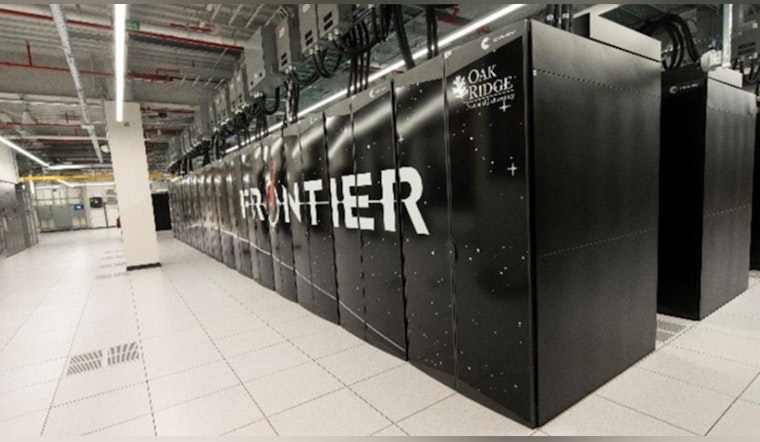
These projects, fueled by ORNL's AI Initiative and the Laboratory Directed Research and Development program, serve as shining examples of how investment in AI technology and supercomputing can potentially revolutionize scientific inquiry and problem-solving. The Frontier supercomputer housed in the ORNL, managed by UT-Battelle for DOE's Office of Science, stands as testimony to the institution's commitment to advancing the edge of what's possible in open science—and these recent awards are likely to further cement this legacy.




