

























































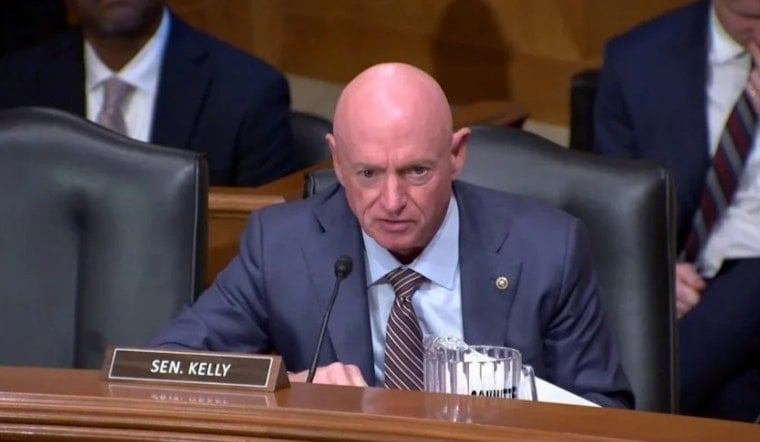
Arizona Senator Mark Kelly used a recent Senate Environment and Public Works (EPW) Committee hearing to secure commitments from Trump administration nominees to move forward on critical infrastructure projects in Arizona that have been stalled amid ongoing federal funding uncertainties.
During the May 14 hearing for Trump nominees Adam Telle and Sean McMaster, Kelly specifically addressed three key Arizona infrastructure projects: the Winslow Levee Project, the Rio de Flag flood control efforts in Flagstaff, and the 22nd Street Bridge replacement in Tucson. All three projects represent critical infrastructure needs for Arizona communities and have faced delays despite having secured federal funding through the Bipartisan Infrastructure Law passed during the previous administration.
The Winslow Levee Project, which received $65.75 million in federal funding through the Bipartisan Infrastructure Law in 2022, aims to remove the town from a 100-year floodplain. The project is particularly vital as the levee has been decertified since 2008 and poses risks not only to local residents but also to a key rail line that transports billions of dollars in goods through Arizona, according to Kelly's office.
Pressing for Progress on Winslow's Flood Control
"The Army Corps of Engineers is constructing this new levy project that will remove the town from a one-hundred-year flood plain. It is fully funded under bipartisan infrastructure law. They have the local match," Kelly emphasized during the hearing. When asked if he would commit to ensuring the Corps moves quickly to complete this infrastructure project, Telle, the nominee for Assistant Secretary of the Army for Civil Works, affirmed he would follow the law and work with the senator and constituents to deliver the facility "as quickly as we possibly can."
The nomination hearing comes at a critical time, following a January 20 executive order from President Trump that paused the disbursement of funds from the Bipartisan Infrastructure Law and created uncertainty for many infrastructure projects nationwide. This "funding freeze" has affected grant agreements for projects like the 22nd Street Bridge in Tucson, as reported by members of Congress who have demanded greater transparency about which projects are being impacted.
Tucson's 22nd Street Bridge in Limbo
The 22nd Street Bridge project in Tucson has been particularly affected by the funding situation. This $111 million project aims to replace an aging bridge built in 1966 that currently cannot support heavy vehicles like buses and emergency vehicles due to structural deficiencies, according to the City of Tucson Department of Transportation and Mobility. Construction was expected to begin in early 2025 and last approximately three years.
Kelly highlighted that the City of Tucson has submitted all required documentation for the federal grant agreement, including NEPA documents and utility and right-of-way clearances, but has received no feedback since December and has been unable to secure meetings with federal officials. "If confirmed, will you commit to prioritizing completing finalized grant agreements that have been caught up in this haphazardly implemented funding freeze like the 22nd Street Bridge?" Kelly asked McMaster, the nominee for Administrator of the Federal Highway Administration.
McMaster responded affirmatively, stating: "I will commit to you that I look forward to supporting the Secretary in his effort to move these projects from award to agreement as quickly and as expeditiously as possible. Lives and money are impacted with any possible delay."
Rio de Flag Flood Control in Flagstaff
Kelly also addressed the Rio de Flag project in Flagstaff, a $122 million flood control initiative that would remove over half of the city's residents and more than 1,500 structures from the floodplain, including Northern Arizona University and the City Hall, according to the City of Flagstaff. The project has been in development for nearly two decades and faces potential issues with what's known as the "902 limit," which could require a Post-Authorization Change Report.
Telle committed to working with the City of Flagstaff to find a way to continue advancing phase one of the project without delay and to ensure any required report would be completed quickly enough to be provided to Congress in time for the Water Resources Development Act (WRDA) of 2026.
Background on the Nominees
Both nominees have experience in infrastructure policy and government service. Adam Telle, nominated to serve as Assistant Secretary of the Army for Civil Works, currently serves as Chief of Staff to Senator Bill Hagerty (R-TN) and previously led the Senate affairs team in the White House Office of Legislative Affairs during Trump's first term, according to the National Waterways Conference. In this position, he would oversee the U.S. Army Corps of Engineers' Civil Works program, which is responsible for flood control projects like those in Winslow and Flagstaff.
Sean McMaster, nominated to lead the Federal Highway Administration, previously served as Deputy Chief of Staff and Deputy Assistant Secretary for Congressional Affairs at the Department of Transportation during Trump's first administration. His experience includes working on the House Committee on Transportation and Infrastructure from 2011 to 2017, according to Engineering News-Record.
Infrastructure Funding Challenges
The exchange during the confirmation hearing highlights ongoing tensions regarding the implementation of the Bipartisan Infrastructure Law under the new administration. President Trump's January 20 executive order, titled "Unleashing American Energy," paused disbursements under both the Bipartisan Infrastructure Law and the Inflation Reduction Act while agencies reviewed their processes for issuing grants and contracts, as reported by Waste Dive.
This funding freeze has created uncertainty for infrastructure projects across the country, with federal courts issuing temporary restraining orders prohibiting the administration from carrying out the freeze. However, reports indicate that some promised government funding has continued to be held back even after the court interventions, according to NPR.
Kelly's questioning of the nominees explicitly acknowledged this funding situation, referring to the implementation as "haphazard" and pressing for commitments to prioritize completing finalized grant agreements for Arizona projects caught in the uncertainty.
Moving Forward
Both nominees committed to working with Kelly to implement the Bipartisan Infrastructure Law and WRDA to complete these projects as Congress intended. For the communities affected, including Winslow, Flagstaff, and Tucson, these commitments represent potential progress on long-awaited infrastructure improvements that are critical for public safety, economic development, and quality of life.
The Winslow Levee Project, once completed, will protect the town against flooding that could harm Arizona families and disrupt supply chains. The Rio de Flag project in Flagstaff will remove significant portions of the city from the floodplain, while the 22nd Street Bridge replacement in Tucson will restore a critical transportation connection that currently cannot support school buses, ambulances, or freight vehicles.
Senator Kelly's office has been instrumental in securing funding for these projects, with the senator working on a bipartisan basis to ensure Arizona communities receive the infrastructure investments they need. The hearing represents another step in his efforts to see these projects through to completion despite the changing federal landscape.



