

























































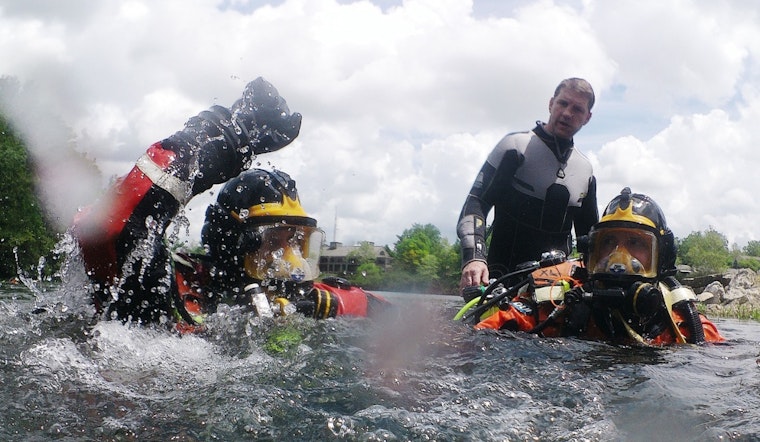
The Columbus Fire Department's Dive and Rescue Team (DART) has expanded its ranks with the addition of seven new certified firefighters to its water rescue operations. As reported by the Columbus Division of Fire on their social media, this team, established in 2004 by Lieutenant Steve Treinish, now comprises 45 dedicated members. These individuals are called upon in a multitude of circumstances, ranging from potential drownings and swimming mishaps to vehicular submersions and icy misfortunes.
Last year alone, the Columbus Fire DART team was dispatched 40 times, embarking on missions to save lives and ensure public safety. The latest additions to their crew — firefighters Jeremy Carpenter, Ryan Kelly, Tanner Kline, Richard Kovacs, Adam Sollenberger, LD Smith and Matthew Tschirner — successfully underwent a rigorous certification process in May, according to the Columbus Division of Fire.
The newly certified firefighters came to the program with impressive backgrounds, including Open water and Advanced Open water recreational diving certifications, along with a few having additional education that proved advantageous in their intensive training. The five-day public safety diver class they completed covered critical skills from the use of dry-suits and full-face masks to executing search patterns, tackling victim recovery, managing entanglements, and operating under zero visibility conditions across Columbus's varied waterways.
Under the guidance of lead instructor Nate Dunmoyer and dive supervisors Mike McConnell and Lt. Bill Ross, the trainees honed their skills in diverse environments, including the Ohio State Patrol training tank and local reservoirs. "It’s completely different. Rec diving, you have good visibility," Firefighter Jeremy Carpenter, a long-time recreational diver and 19-year service veteran, told the Columbus Division of Fire when asked about the contrast between recreational and DART diving. "The gears a little bit different, usually you don’t have dry suits on. This (rescue diving) you have dry suits on. You have more weight, visibility is terrible, you are usually on the bottom stirring things up so you can’t see," he explained.
Additionally, the Columbus Division of Fire shared that the rope system used in DART operations serves dual purposes — as a means of communication and as a safety line that can reorient or pull divers back if necessary. Highlighting the often perilous conditions they face, Carpenter spoke of near-zero visibility in Ohio waterways, with the waters clouded to the point where particles can seem to rush at a diver, an experience that sometimes borders on the surreal. These trained professionals navigate this underwater obscurity to conduct search patterns and rescue simulations, effectively preparing them for the exigencies they may face in the field.
As Lt. Steve Treinish coined it, this period of late Spring is dubbed "the drowning season", a time when the disparity between warm air and cold waters can lure people into dangerous situations. He implores the public to avoid swimming alone, especially in unguarded bodies of water and to exercise caution around local quarries. Notably, Runaway Bay has seen four fatalities, as mentioned by Treinish, amplifying the necessity for well-trained DART members.
The Columbus Fire DART team operates out of Fire Station 2 on 150 East Fulton Street, with a guaranteed round-the-clock staffing of at least two divers. And now, with 45 firefighters DART-certified, these individuals stand ready across the City’s 34 fire stations to respond to any water rescue emergency that may arise.





