

























































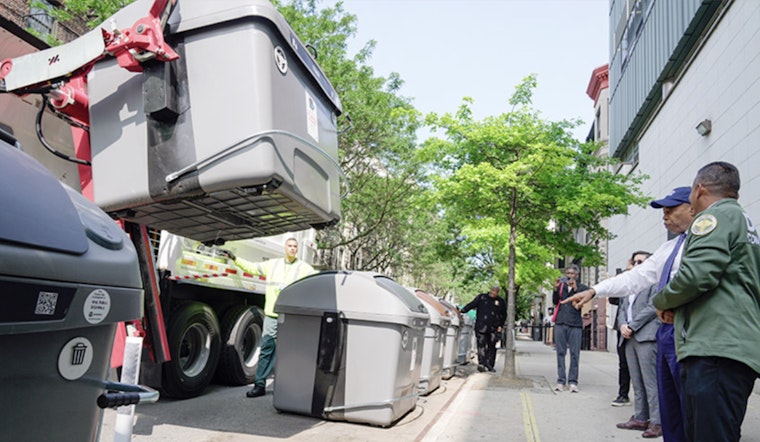
New York City is undergoing a significant change in its efforts to manage waste and control rodents, as Mayor Eric Adams and Acting Commissioner of the Department of Sanitation (DSNY), Javier Lojan, announce the full rollout of containerized trash collection in West Harlem. In a statement obtained by the Mayor's Office, Adams celebrated the achievement, declaring, "We now have a fully containerized neighborhood in Harlem — the first in North America — and have seen six straight months of fewer rat sightings with cleaner sidewalks and clearer corners." The Mayor's Office notes that this milestone follows the installation of roughly 1,100 on-street containers, known as Empire Bins, which are serviced by specially designed trucks that were developed far ahead of the predicted schedule.
These Empire Bins, which are distinct to individual buildings rather than shared on a block, represent a significant advance in the city's waste management strategy. Acting Commissioner Lojan, reflecting on his time since 1999 in the sanitation department, proclaimed the day marked a leap forward, having "seen too many good people get hurt from throwing bags or sick with leptospirosis," as reported by the Mayor's Office. Owned by property owners, the bins are accessed using key cards, addressing the historical challenges of trash management in highly populated areas like New York City.
According to the same announcement, the Adams administration explored various avenues, including community engagement and volumetric analysis, to develop the new trash containment strategy. Businesses throughout New York City had already transitioned to bin usage in March 2024, with residential buildings following in November 2024. This dual approach containerized approximately 70 percent of the city's trash. Paired with the introduction of a new, automated, side-loading garbage truck, these measures stand as a testament to the administration's pro-active leadership in municipal cleanliness and pest control.
The ongoing pilot program in West Harlem will provide valuable data for further advancements and potential expansion throughout the city. DSNY staff will analyze outcomes in the weeks and months to come, as indicated by the DSNY Acting Commissioner Lojan, who told the Mayor's Office, "Today marks a giant leap forward for our city." These efforts are expected to improve efficiency by reducing the amount of time waste remains on the streets. The Adams administration implemented operational changes that shifted a significant portion of trash collection to midnight instead of the early morning hours.
Aside from practical outcomes, these changes reflect Mayor Adams' broader "Trash Revolution," an endeavor to enhance the city's street cleanliness through various policy implementations. As a part of the Fiscal Year 2026 Executive Budget, which has been dubbed the "Best Budget Ever," over $32 million in permanent funding has been committed to support DSNY's initiatives, solidifying the administration's commitment to preserving the cleanliness and living quality of New York City for future generations, according to the Mayor's Office.





