

























































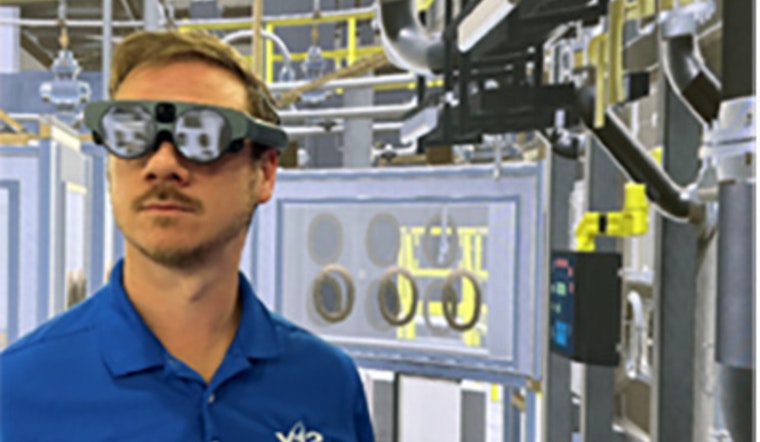
Y-12 National Security Complex's Oak Ridge Enhanced Technology and Training Center (ORETTC) is stepping up its game by utilizing extended reality (XR) to train in high-stakes scenarios that would be too risky in the real world. Gran Turismo gamers may have gotten a taste of what it's like to swap virtual speedways for real tracks due to Sony’s simulator's eerily accurate depiction of high-speed driving. ORETTC, however, is applying XR to train first responders and operators for those nail-biting, low-occurrence but potentially catastrophic situations, as reported by Y-12 News.
The technology used at ORETTC includes augmented reality, virtual reality, mixed reality (MR), and haptic feedback gloves. The goal is to immerse trainees in realistic scenarios without the associated risks. Using platforms like Unreal Engine and Unity, the center creates high-fidelity digital twins of real-world environments and operations. “these XR training simulations are best‑in‑class and act to fully immerse the trainee” said PDRD Program Manager Mark Richey, according to Y-12 News. “XR literally takes ‘hands‑on’ to a whole new level.”
ORETTC has expanded its capabilities into the Internet of Things (IoT), enabling remote operation of devices such as starting a motor at the University of Tennessee, Knoxville from their home base. Digital twins enhance machine reliability and allow us to solve complex problems, said Scott Couture, senior director of Production Research, Development, and Integration. The center’s XR technology also enables real-time collaboration across distances, with applications such as connecting experts from different coasts to address a patient’s needs, as highlighted by Erik Nykwest, Y-12 Development multi-physics scientist. Mary Lin, interim director of ORETTC, discussed the center’s advanced technology and its potential impact.
ORETTC isn't just revolutionizing training with, simulations and remote collaboration; they're redefining tactile experience with haptic feedback in Mixed Reality Glovebox Training. The fancy gloves let chemical operator trainees feel force, texture, and resistance, mimicking real-life situations closely. It prepared personnel for high-risk tasks "without real-world consequences," Kim Nickell, Production Activities Training manager, told Y-12 News, "Trainees have the opportunity to practice high‑risk scenarios without real‑world consequences." It's all about getting workers quickly up to speed, safely, and effectively.
The focus at ORETTC on R&D around XR technology aims at directly advancing the manufacturing realm and bolstering the primary goals of the National Nuclear Security Administration (NNSA). Whether it's about immersive digital twins, haptic feedback systems, collaborative XR, or next-gen XR environments, ORETTC seeks to drive innovation squarely rooted in addressing genuine operational necessities. By doing so, they’re working to ensure that the manufacturing ecosystem remains adaptable and primed for whatever the future holds. It's about staying ahead, as projects like these aim to lift the standards and operations to new heights of excellence.





