

























































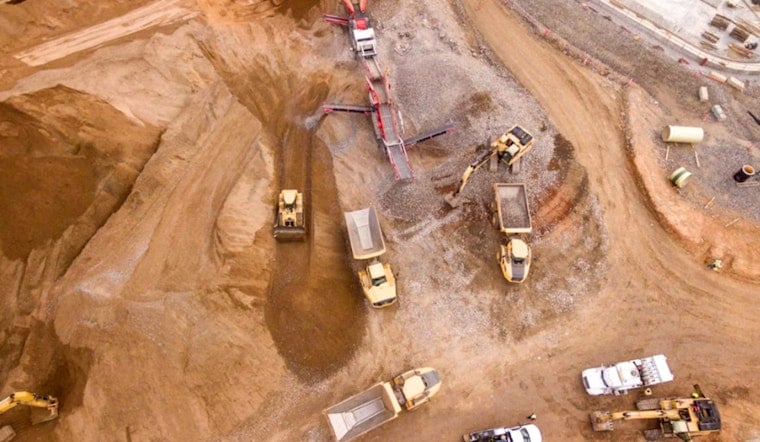
State regulators say an active quarry north of the Nolichucky River in Mitchell County was operating without state approval — a discovery that came after a federal request for miner safety training led North Carolina Labor Department staff to the site. Officials have since asked a judge to halt operations and require stabilization of disturbed land while permitting plays out.
How the mine was uncovered
The North Carolina Department of Labor (NCDOL) says the unauthorized operation was identified after the federal Mine Safety and Health Administration requested state-conducted miner safety training at the site operated by Horizon 30, LLC. During that visit, an experienced NCDOL official noted “multiple irregularities” and asked to see state environmental permits; none were produced. In a press release, NCDOL described the finding as the result of routine field vigilance.
As a result of that referral, the state Department of Environmental Quality (DEQ) confirmed the operation lacked the required mining permit and has been pursuing enforcement actions. According to state filings, legal proceedings are now seeking an injunction that would force the site to halt mining or otherwise assure environmental protections while a permit is processed.
What regulators say about the operation
DEQ documents and local reporting show Horizon 30 filed a mining permit application (No. 61-22) for what it calls the Carter Quarry; the application describes a roughly 50.8-acre project with about 23.3 acres to be actively excavated and proposed depths averaging 130 feet, with maximum cuts to 550 feet. State inspectors say the operation was at work for months before the department deemed the site unpermitted.
Officials from the N.C. Department of Justice, representing DEQ, told a court that if left uncorrected there is a “substantial possibility that the mining would result in imminent peril to life or danger to property or to the environment,” language taken from the agency’s complaint. The state is asking a N.C. Superior Court judge to require Horizon 30 to cease operations or immediately stabilize disturbed areas while the permitting process continues.
Timeline and enforcement steps
Timeline details in inspection reports and news coverage show regulators first flagged disturbance at the site in early 2025. DEQ inspectors observed activity in February and issued Notices of Violation and of Continuing Violation in March through June after finding roads and cleared acreage. Horizon 30 submitted an initially incomplete application in April and later paid fees to complete the filing, but DEQ says mining continued despite repeated verbal and written orders to stop.
Because the site abuts the Nolichucky River and is being considered as a source of rock for nearby rail repairs, DEQ officials have also raised air-permit and water-quality concerns tied to crushing operations and disturbed soils. Those details come from the agency’s mining docket and reporting by regional news outlets.
Local context and past disputes
Mitchell County sits in a long-standing mining region of western North Carolina where quarries and pegmatite operations have historic economic importance, but also a track record of contentious permitting fights and environmental scrutiny. State mining law requires reclamation plans, operating fees and annual reporting; failure to follow those rules can lead to daily fines and court-ordered injunctions. DEQ’s public docket for the Horizon 30 application includes maps, inspection reports and a public hearing record that drew local comment.
Legal implications
The state’s tools here are civil enforcement: notices of violation, daily penalties, and injunctive relief via the courts. If the judge grants the requested injunction, Horizon 30 would be required to stop mining until a valid permit and required environmental reviews are in place or to immediately stabilize and reclaim disturbed areas if operations cease. The company could also face fines for continued noncompliance; state rules cap certain daily fines but cumulative penalties and court orders can carry significant financial consequences. These are the remedies DEQ and the Department of Justice have pursued in similar unpermitted mining cases, according to agency records and public filings.
What’s next
The DEQ held a public hearing in late July on the Horizon 30 permit application at the former Bowman Middle School in Bakersville, and agency dockets remain open for formal comment and review. The state’s request for an injunction is set for a hearing in superior court; until a judge rules, regulators say they will monitor the site and press for protective measures to limit sediment and air impacts.
Meanwhile, NCDOL officials framed the discovery as an example of cross-agency cooperation and the importance of field staff vigilance. "This is exactly why I’ve made it a priority to support and empower our field staff," Labor Commissioner Luke Farley said in the department’s release.
Sources and where to read more
Background, the agency release and the state’s description of the discovery were provided by the N.C. Department of Labor. Local reporting with inspection details and the state’s court filing is summarized by Blue Ridge Public Radio. Additional coverage and timeline reporting is available from WRAL and WSOC/WSOTV. The state DEQ mining program hosts the Horizon 30 application materials and public hearing documents on its site for review.





