

























































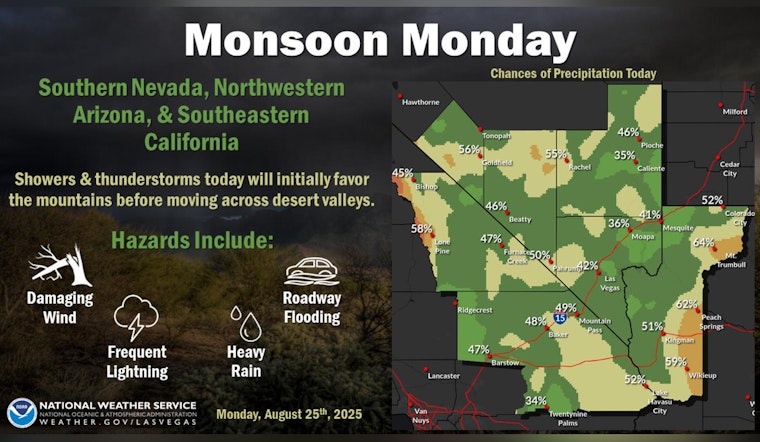
Strong monsoon storms are sweeping across the Las Vegas Valley Monday, bringing the threat of flash flooding, damaging winds, and hazardous road conditions through the night. According to Country Herald, the storms are affecting southern Nevada, northwestern Arizona, and southeastern California as they move from mountain ranges into desert valleys.
The National Weather Service in Las Vegas reports that several waves of thunderstorms are expected through late Monday, increasing the likelihood of flooding in Las Vegas, Henderson, and Boulder City. The storms will produce heavy rain, frequent lightning, and roadway flooding as they drift from mountainous areas into valley locations.
Heat and Flash Floods: A Deadly Desert Combination
The North American Monsoon brings what meteorologists describe as the United States' two deadliest weather phenomena to Southern Nevada each year. As reported by the National Weather Service, moisture associated with the monsoon typically moves into the Mojave Desert during July and August, bringing higher humidity and triggering scattered thunderstorms that develop in surrounding mountains before moving into the valley.
The dangers are significant and well-documented. At least 35 people have died from flooding in Southern Nevada since 1960, with three fatalities reported last year alone. Two victims were homeless individuals living in flood channels who were swept away, while a third was a 13-year-old boy who drowned after being pinned under a parked car while inner tubing down a flooded street.
Infrastructure Investments Paying Off
The Clark County Regional Flood Control District has made substantial investments in valley protection over the past four decades. According to Clark County officials, the district has invested $2.5 billion in building 110 detention basins, 713 total miles of flood channels, and 222 real-time rain gauges.
These investments are showing results, particularly through projects like the Tropicana Detention Basin. The $7 million facility, completed in 1998, protects key areas including Allegiant Stadium, nearby railways, the Las Vegas Strip, Harry Reid International Airport, and UNLV from flooding. The basin was part of a larger $335 million Army Corps of Engineers project featuring five detention basins, three debris basins, and 28 miles of primary channels.
Climate Change Altering Flood Patterns
Recent research from the Desert Research Institute reveals troubling trends about regional flooding. Scientists found that urbanization and climate change are altering both the strength and seasonality of flooding in the Las Vegas area, with flood intensity increasing since the mid-20th century and an abrupt shift occurring in the mid-1990s.
The analysis shows average annual peak flood flows jumped dramatically from about 530 cubic feet per second between 1950 and the mid-1980s to over 3,100 cubic feet per second in the following decades, despite rainfall totals increasing by only about 0.08 inches annually. Climate change has also shifted flood seasonality, with storms and floods now occurring more frequently in winter rather than the historically stronger summer monsoon season.
Safety Precautions for Valley Residents
As storms continue threatening the region, officials emphasize basic safety measures. "These storms are very moisture-laden. They can put down an inch of rain in 15 to 30 minutes, and they can happen really fast," Chris Outler, lead forecaster from the National Weather Service, told 8 News Now. He noted strong winds often pose the biggest impact during monsoon storms, with gusts easily reaching 60 mph in intense systems.
Officials warn that as little as 6 inches of water can knock a person off their feet. During storm events, residents should shelter in place to avoid being caught in flash floods. The National Weather Service continues advising residents to avoid low-water crossings and prepare for rapidly changing conditions as volatile weather persists through the remainder of the monsoon season.





