

























































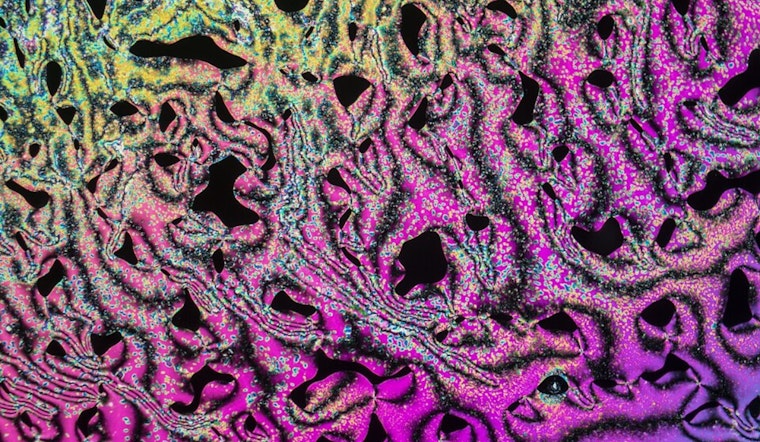
In a leap for technology that could shake up the world of memory storage, researchers at The Ohio State University have nailed down a new method for liquid crystals to retain movement information. This intriguing development suggests that liquid crystals, a staple in our everyday LCD screens, might just be paving their way towards becoming key players in the future of smart and flexible soft materials.
This isn't just about getting crystal clear images on your TV or phone anymore. The study, recently featured on Ohio State's news site, discusses how this method might be a game-changer for memory devices and sensors. Traditional everyday materials use molecules in a consistent pattern, but the researchers are taking things up a notch by achieving what's called polar order, getting all the liquid crystal molecules facing one direction.
But here's the kicker: according to Xiaoguang Wang, an assistant professor in chemical and biomolecular engineering at Ohio State, and co-author of the study, this task isn't exactly a walk in the park with soft materials.
“Soft matter can’t compete with existing solid-state storage in speed, reliability, or miniaturization, so the question becomes how might we control its internal structure to make it competitive or comparable to traditional hard materials,” Wang told the Ohio State University publication. In their revolutionary approach, scientists leveraged external forces to nudge these interesting liquid crystals into action. The team's experiments involved etching pillars into silicon and infusing liquid crystals in the nooks, and then cranking up the wizardry with a layer of water.
Imagine how a magnet behaves in an electric field, with its poles aligning according to the force applied. That's kind of what happened here when a water droplet was moved over these liquid crystals—the molecules were quick to line up in the new direction. Even more compelling, when these guys ran their experiment again, the liquid crystals remembered their prior orientation, basically showing that they're capable of working like memory devices that can recall their past states. "It can memorize the directionality of the information that we write into it, which means that our vector-based system operates like a memory device," said Wang in the original study, according to Ohio State News.
Ufuoma Kara, lead author of the study and a former Ohio State graduate research associate, doesn't hold back on the potential ramifications of this discovery. Expanding knowledge that can be baked into these systems could lead to the exploration of novel applications and physics. As the research continues to mature, envisioning a future where liquid crystals double up as miniature computer processors and reprogrammable memory storage isn't far from possible.
The collaboration was broad, with contributions from Ohio State team members Boyuan Chen, Rajdeep Mamtani, Yang Xu, Alan Weible, Eric Boerner, Zhan Yang, and other scholars from the University of Ljubljana, Georgia Institute of Technology, California Institute of Technology, and Kent State University. This research was supported by a slew of interested bodies, including the National Science Foundation, the Ohio State Materials Research Seed Grant Program, among others. For more insights into the study, check out the full article published by Ohio State News.





