

























































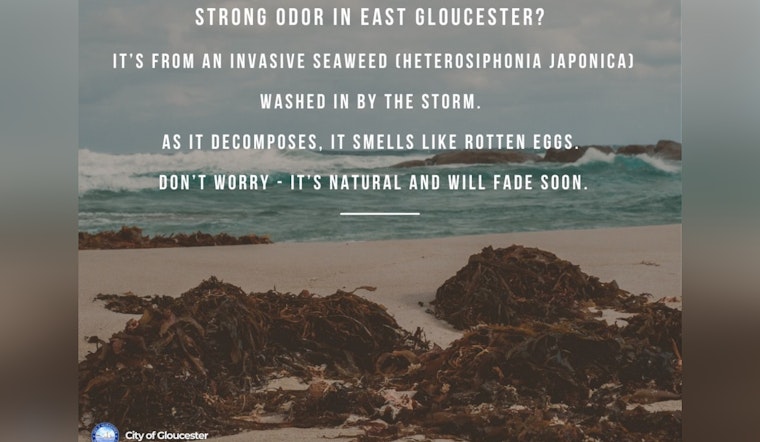
Residents of Gloucester on the North Shore have been reporting an overwhelming and unpleasant "rotten egg" odor saturating the air, an aftereffect of Hurricane Erin. The City of Gloucester addressed concerns on social media, attributing the stench to a large amount of Heterosiphonia japonica, an invasive Japanese seaweed, decay along the shoreline. "It’s a natural process," to read a statement shared by the city, as per a report from MassLive.
Hurricane Erin, despite passing hundreds of miles from the coast in late August, caused significant enough disturbance to push substantial amounts of seaweed to shore and into the Good Harbor estuary. With no strong tides to properly transport the debris back out to sea, it has begun to decompose and to release hydrogen sulfide - the gas responsible for the sulfuric odor. As noted by city officials and shared by Boston25 News, "The odor should fade as the seaweed breaks down."
Known also as Dasysiphonia japonica, this seaweed not only disrupts the olfactory senses of locals but also poses broader ecological and economic threats. Originating from the Northwest Pacific, Heterosiphonia japonica rapidly proliferates along coastlines, potentially causing die-offs of fish due to decay and interfering with local commerce by clogging fishing nets and lobster traps, according to research cited by MassLive. The seaweed requires weeks, if not months, to completely decompose.
To curb further spread and impact, the Massachusetts Office of Coastal Zone Management recommends various mitigation strategies. Among them, boaters are advised to closely inspect and clean their vessels to remove attached seaweed, never to release bait or bait materials into water bodies, and to properly dispose of seafood waste. Consumers can also play a role by choosing local seafood and refraining from releasing non-native species into the environment. These efforts, seemingly simple in their application, might prove critical in preserving the integrity of affected ecosystems.



