

























































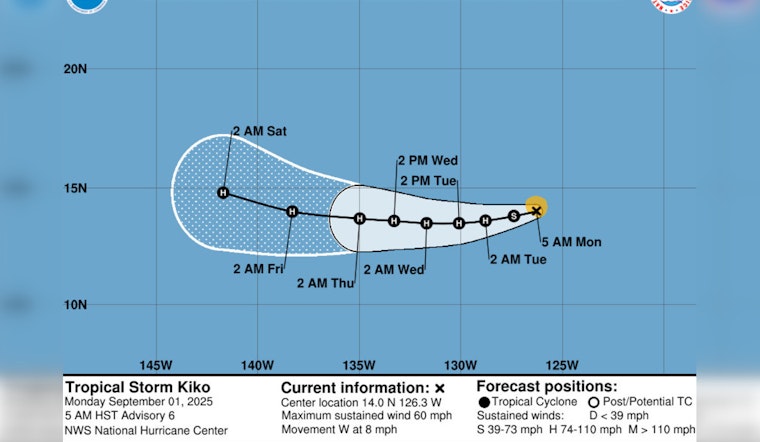
Hurricane Kiko has officially strengthened to Category 1 status as it churns through the eastern Pacific, with maximum sustained winds reaching 75 mph as it continues its slow westward track that could potentially bring impacts to Hawaii next week.
According to Hawaii News Now, the storm was located approximately 1,840 miles east of Hilo early this morning. This makes it the latest named system to develop during what meteorologists predicted would be a relatively quiet Pacific hurricane season for Hawaii.
Rapid Intensification Expected
The hurricane is gaining strength in favorable conditions and forecasters expect further intensification. As reported by Big Island Video News, despite somewhat drier mid-level conditions along its forecast track, the combination of light vertical wind shear, warm sea surface temperatures, and Kiko's small compact core should allow for strengthening in the short term. Rapid intensification probabilities have increased over the past 24 hours, with around a 30–40 percent chance of a 30-knot increase in the next 24 hours.
AccuWeather lead hurricane expert Alex DaSilva told Newsweek that "Kiko is over very warm water right now and it is expected to become a Category 2 hurricane by tomorrow morning." He added that due to the very warm water, it cannot be ruled out that the hurricane could reach major hurricane status over the next few days.
Track Toward Hawaii Uncertain but Worth Watching
The storm is expected to continue on a generally westward track for the next few days, then make a turn toward the west-northwest by Friday or Saturday. Hawaii News Now reports the current forecast shows it tracking toward Hawaii, but it's too soon to say exactly where it will go.
Hurricane experts believe the Big Island of Hawaii could at least have increased wave activity early next week, with tropical downpours and gusty winds also a potential concern if Kiko passes close enough to the islands.
However, according to Newsweek, "it is certainly possible that the storm could trend north or south of the [Hawaiian] islands and bring little to no direct impacts." As the storm approaches the islands, it will move over cooler water, which should help reduce the wind intensity.
2025 Hurricane Season Context
This development comes during what NOAA forecasters predicted would be a relatively quiet Central Pacific hurricane season. Forecasters announced a 30% chance of below-normal tropical cyclone activity for the central Pacific, with a 50% chance of a near-normal season and a 20% chance that it will be above-normal. The forecast calls for 1-4 tropical cyclones across the central Pacific.
As per Wikipedia, tropical activity in the Central Pacific commenced in late July, with the formation of Hurricane Iona on July 27 and Tropical Storm Keli the following day. Both tracked to the south of the Island of Hawaii, with Iona crossing the International Date Line.
Historical Context for Hawaii
Hawaii's track record with tropical cyclones provides important context for current concerns. According to Kauai Now, of some 72 tropical cyclones that have impacted the islands since the mid-20th century, Hawaii's record shows about only 12 of them making landfall - nearly a 20% chance or almost 1 in 5.
Recent memory includes the devastating impact of Hurricane Dora, which passed well south of the state in August 2023 but led to ferocious gusts. As detailed by Hawaii News Now, the wind storm fanned the flames that ultimately destroyed parts of Upcountry Maui and Lahaina, with 101 lives lost and more than 2,200 homes and businesses burned to the ground.
Current Conditions and Monitoring
Currently, Kiko is still too far away to affect the islands, and KITV reports there are no watches or warnings in place. Local weather in Hawaii remains fairly typical for early September, with mostly calm conditions expected today.
The storm is forecast to cross into the Central Pacific Saturday, at which point the Central Pacific Hurricane Center in Honolulu will take over forecasting responsibilities from the National Hurricane Center in Miami. As one expert noted to Kauai Now, "It only takes one storm to change your life, your family, your 'ohana and your community." Even during seasons when the outlook calls for below normal tropical cyclone activity, storms that do develop can impact the islands.
As Hurricane Kiko continues its westward journey through the Pacific, Hawaii residents and emergency officials will be monitoring its progress closely, knowing that while the storm remains far from shore, the next several days will be critical in determining whether the islands face their first significant tropical threat of the 2025 season.





