

























































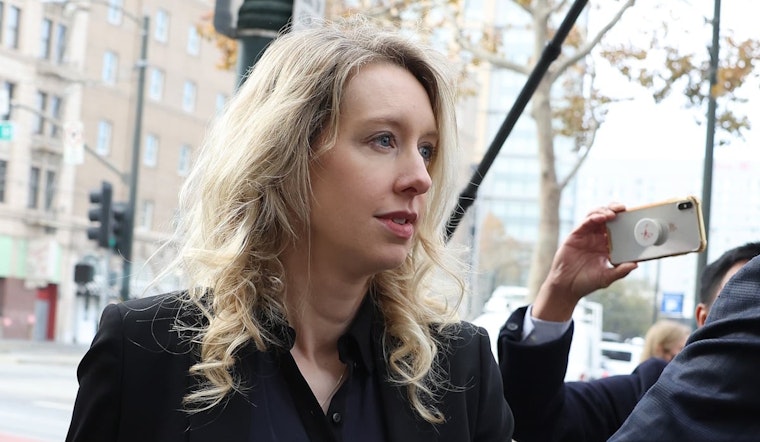
Elizabeth Holmes is tweeting again, which wouldn't be particularly noteworthy except for two small details: she's been silent on social media for nine years, and she's currently serving an 11-year sentence in federal prison where inmates are explicitly banned from using social media.
The disgraced Theranos founder updated her X bio to read "Mostly my words, posted by others" before launching what appears to either be a carefully orchestrated rehabilitation campaign or somebody impersonating the once-believed wunderkind. Assuming it is the former, her strategy involves appropriating civil rights leaders' words while spinning her incarceration as a fitness success story and positioning herself as an advocate for other imprisoned women.
"There comes a point where we need to stop just pulling people out of the river. We need to go upstream and find out why they're falling in." -Archbishop Desmond Tutu
— Elizabeth Holmes (@ElizabethHolmes) August 27, 2025
The timing feels particularly calculated, coming on the heels of a billboard campaign that espouses Holmes' innocence and just months after the Ninth Circuit Court shut down her last realistic chance at overturning her conviction. With her legal options essentially exhausted, Holmes has pivoted to social media rehabilitation.
When Legal Appeals Fail, Try Twitter
Holmes' Twitter comeback follows a brutal legal losing streak that started in Bay Area federal courts. Her 2024 appeal to the Ninth Circuit went nowhere, with federal prosecutors arguing that "every motion was litigated to death" during her original trial. The court wasn't buying her lawyers' claims that prosecutors relied on assumptions rather than concrete evidence.
The Ninth Circuit panel was particularly harsh, describing Theranos' technology as a "mirage" and Holmes' statements as "half-truths and outright lies." When she tried for a full rehearing with more judges, the court delivered a brutal four-sentence rejection that left her with only the Supreme Court as an option—a path that rarely succeeds.
Suddenly, Holmes is sliding into the replies of Bryan Johnson, the San Francisco-connected longevity guru who spends millions trying to reverse aging and hosts expensive wellness summits around the Bay Area. When Johnson tweeted about "defeating death," Holmes' account responded with enthusiasm:
— Elizabeth Holmes (@ElizabethHolmes) August 27, 2025
When Johnson posted about facing criticism for his extreme biohacking lifestyle, she offered encouragement within minutes: "First they think you're crazy, then they fight you, then you change the world." The rapid-fire responses suggest either someone is reading Johnson's tweets to her during monitored phone calls, or whoever manages her account is taking serious liberties with that "mostly my words" disclaimer.
Federal Prisons Don't Play Games
Holmes is currently at Federal Prison Camp Bryan in Texas, where communication rules are crystal clear. Inmates can buy tablets for entertainment and education, but they have zero internet access. Phone calls are monitored, limited to 15 minutes, and social media use is strictly forbidden.
The consequences for violating these rules can be severe. When Martin Shkreli was caught using a contraband cellphone to run his pharmaceutical company from prison, CBS News reported that authorities immediately threw him into solitary confinement.
Holmes appears to be using a safer approach, following the playbook established by other high-profile inmates. TIME documented how Chelsea Manning maintained an active Twitter presence while imprisoned by dictating tweets through phone calls to a communications firm.
The Family Business Continues
Holmes' sudden interest in longevity science isn't random. Her partner Billy Evans has been building Haemanthus, a blood-testing startup powered by AI and "friggin laser beams" that promises revolutionary medical diagnostics. The company insists it's "not Theranos 2.0," but the similarities are uncomfortable.
824 days in prison, 824 workouts pic.twitter.com/j14jz9NdGy
— Elizabeth Holmes (@ElizabethHolmes) August 31, 2025
Evans is raising millions from Bay Area investors despite his connection to Silicon Valley's most spectacular fraud. NPR confirmed Holmes is advising Evans on the company despite having no formal role—a distinction that feels meaningless given their personal relationship and shared children.
Johnson, whose Blueprint protocol and Don't Die events have attracted Bay Area tech elite willing to pay thousands for longevity advice, seems an ideal target for Holmes' attention. Nucleus documented his participation in San Francisco wellness events, where his extreme anti-aging regimen draws crowds of optimization-obsessed entrepreneurs.
Rewriting Her Own Story
Holmes' recent tweets reveal a calculated narrative shift. She's not just posting inspirational quotes—she's positioning herself as a victim of systemic injustice while claiming to advocate for other women facing legal troubles:
I keep this by my side as I work on cases for women who never stood a chance in this system in which they are presumed guilty until we can prove their innocence. pic.twitter.com/f38pKJl4v8
— Elizabeth Holmes (@ElizabethHolmes) September 2, 2025
This messaging represents an extraordinary level of audacity. Holmes is claiming to "work on cases" for other women while serving time for securities fraud—essentially positioning herself as a prison activist fighting systemic injustice rather than someone who defrauded investors and endangered patients with faulty medical technology.
The coordinated nature of her social media comeback coincides with other rehabilitation efforts, including pro-Holmes billboards that appeared in major cities earlier this year claiming her innocence. Red Banyan suggests the messaging campaign could be preparation for appeals or early release considerations.
The Bay Area Reckoning That Never Came
Holmes' prison tweets highlight Silicon Valley's ongoing struggle with accountability. While San Francisco rebuilds its downtown through initiatives like Cinema on the Square and new restaurant openings, the region's most notorious fraudster continues working to control her narrative from behind bars.
The timing of her social media rehabilitation campaign is telling. It comes after her appeals were systematically rejected by federal courts and while her partner continues pitching investors on what critics call "Theranos dressed in a different turtleneck sweater vest."
The fact that someone can orchestrate a social media rehabilitation campaign while serving time for securities fraud says something unsettling about Silicon Valley's capacity for reinvention. Even from Federal Prison Camp Bryan, Holmes demonstrates that some tech industry habits—particularly the relentless pursuit of narrative control—are hard to break.





