

























































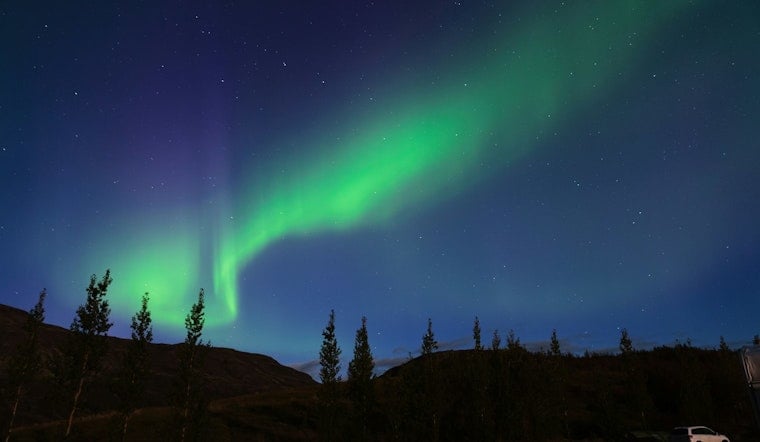
New Yorkers and residents in several northern states may have the chance to witness the Northern Lights early this week, thanks to a full-halo coronal mass ejection (CME) that exploded from the Sun on Saturday. As reported by FOX5NY, the National Oceanic and Atmospheric Administration (NOAA) has issued a Geomagnetic Storm Watch that will remain in effect through Tuesday.
Those looking to catch a glimpse of the celestial light show should aim to find a location with a clear view to the north, avoiding the pervasive light pollution of urban centers. The best viewing time is predicted to be in the early hours of Tuesday morning, specifically between 10 p.m. on Monday and 2 a.m. on Tuesday, as noted by NOAA and shared by FOX5NY. While the lights are a rare sight this far from the poles, the strength of Monday's CME gives hope to skygazers across the state.
Meanwhile, CBS News expands on the potential visibility of the auroras beyond New York, indicating enthusiasts in 18 U.S. states could be in for a treat. While this show might not rival the intensity of auroral displays from previous years, it still presents a significant opportunity for spectators in Alaska, Montana, the Dakotas, Midwest, and even parts of the Northwest to view the Northern Lights.
The sun's current active phase is part of its natural 11-year cycle, where magnetic polarity shifts and can lead to increased solar flares and CMEs. According to NOAA's Kp index forecast, the geomagnetic storm is expected to peak sometime between 2 a.m. and 5 a.m. ET on Tuesday, which aligns with FOX5NY's reported viewing times. Experts advise aurora-watchers to find a dark, serene environment such as a local or national park to optimize the experience, with the added recommendation to check the weather forecast, since cloudy conditions could entirely obscure the spectacle.
For those eager to understand more about what causes such a display, a CME is a solar phenomenon where charged particles are ejected from the Sun, and upon colliding with Earth's atmosphere, can create the beautiful auroras known as the Northern and Southern Lights.





