

























































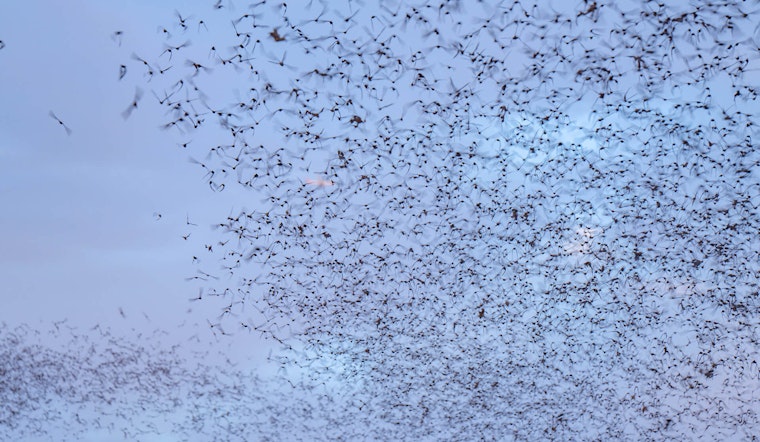
As the Round Rock bat season approaches its twilight, the McNeil Bridge has become a spectacle for those eager to observe the flight of the Mexican free-tailed bats; these creatures, while they might seem inconspicuous, hold a significant ecological role. With September drawing to a close, the bats are set to depart for their annual migration to warmer Mexican caves, according to a report by the City of Round Rock.
The local bat colony, a smaller cousin to Austin's famed North America's largest urban bat population, has its own impressive numbers with over half a million Mexican free-tailed bats residing under McNeil Bridge, as Fran Hutchins, director of Bracken Cave Preserve, mentioned the Round Rock colony appears on Doppler radar daily and it's a remarkable sight, especially considering the significant distance these bats travel nightly in their foraging expeditions sometimes extending as far as 60 miles from their roost. Hutchins told the City of Round Rock.
These bats are not only a natural wonder, performing evening acrobatics as they emerge en masse for their nocturnal feeding, but they are also important pest controllers, consuming large quantities of insects which could otherwise devastate agricultural crops. Each bat consumes about half its body weight in insects every night, focusing on pests larger than the average mosquito and fly.
Come dusk, typically between 7:30 and 8 p.m., the McNeil Bridge serves as a launchpad for these nocturnal beings as they venture eastward into the night, the time they emerge varies with some waiting until near darkness to take flight and once the sky welcomes them, they stay out most of the night making sure to return by dawn to avoid any aerial threats, Hutchins noted to City of Round Rock.
While their flight speeds can reach astonishing velocities up to 98 miles per hour, the reproductive cycle of the Mexican free-tailed bat is slow, producing just one pup per year, rendering them vulnerable to threats that could lead to their extinction. These bats contribute enormously to agriculture and human health savings, with scientists estimating their insect control benefits at over $23 billion annually worldwide. By the end of September and into October, the McNeil Bridge colony will have almost entirely embarked on their migration, leaving locals with limited time to witness their dramatic departures.





