

























































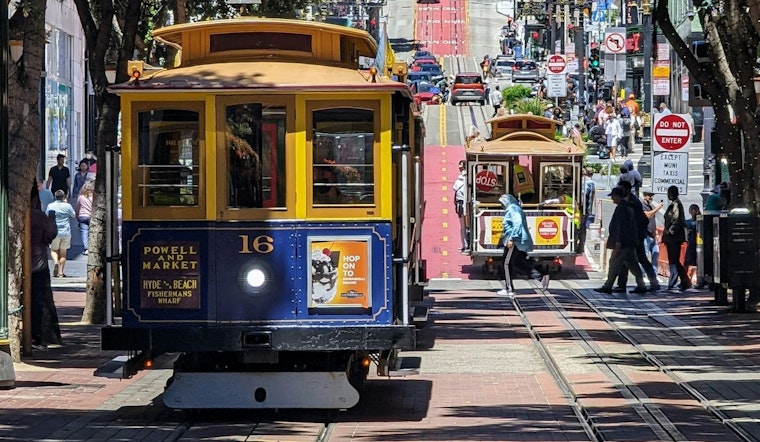
San Francisco's tourism industry is finally catching its breath after years of pandemic-induced wheezing, though don't expect any victory laps just yet. The latest numbers suggest The City is inching toward something resembling normalcy—emphasis on inching.
The projections released Wednesday at the Grand Hyatt San Francisco tell a familiar story of slow, steady progress rather than triumphant comeback. Visitor volume should hit 23.49 million in 2025, up from 23.06 million in 2024, while spending is forecast to climb to $9.35 billion from $9.26 billion, according to the SF Examiner. For 2026, the numbers look even better—24.02 million visitors spending $9.83 billion—though both figures remain stubbornly below 2019's peak of 26.2 million visitors and $10.2 billion in spending.
Leading this measured comeback is Anna Marie Presutti, who made history in September as the first female CEO in SF Travel's 115-year existence. The hotel industry veteran didn't exactly inherit a dream scenario, but she's approaching the challenge with the kind of no-nonsense optimism you'd expect from someone who's spent two decades navigating San Francisco's notoriously fickle hospitality landscape, as detailed by San Francisco Travel.
Moscone Center Becomes the Hero
The real action is happening at Moscone Center, where convention bookings are carrying the tourism recovery on their shoulders. The facility will host 34 events in 2025—generating nearly 657,000 associated room bookings, a substantial 64% surge over 2024's lackluster performance. Microsoft Ignite is making its San Francisco debut, Salesforce's Dreamforce is locked in through 2027, and the Game Developers Conference continues its annual pilgrimage to SOMA, according to San Francisco Travel.
But 2026 tells a more complicated story. Currently, just 30 events are booked at Moscone—translating to 39,000 fewer hotel-room bookings than 2025's projections. Chief Sales Officer Nicole Rogers sounds confident that additional bookings will materialize, though industry insiders know that confidence and signed contracts are entirely different animals.
The Trump Administration Complication
International tourism presents the industry's biggest headache, with overnight international visitors expected to fall 3.2% to 2.26 million in 2025, spending down 2.7% to $4.89 billion. Industry experts aren't being subtle about the cause: Trump administration immigration policies and hiked visa fees are making America a less appealing destination, particularly for Canadian and Mexican travelers, as reported by the Chronicle.
"We just can't control" federal policies affecting international travel, Presutti acknowledged, displaying the kind of diplomatic frustration that comes with running a tourism organization during politically tumultuous times. The irony stings: foreign visitors represent less than 30% of overnight guests but historically account for over 60% of total spending—exactly the high-value customers every destination desperately wants.
Hotels Banking on Better Days
The hotel sector, which endured what Hotel Council President Alex Bastian diplomatically termed a "ruthless" 2024, is cautiously optimistic about occupancy improvements. Projections call for 65.2% occupancy in 2025 with average daily rates of $232.63, climbing to 66.3% occupancy and $241.16 rates in 2026. The city's four-week rolling average hit 71.3% in May 2024, up from January's depressing 43.7%—swings that perfectly capture this recovery's roller-coaster nature, according to city data.
Jon Handlery, whose family has operated the Handlery Union Square Hotel for generations, genuinely believes The City has made meaningful progress in rehabilitating its reputation. The sentiment isn't just industry spin—Handlery's 377-room property on Geary Street has weathered tourism's feast-or-famine cycles long enough to recognize authentic momentum when he sees it.
The 2026 Mega-Event Gamble
Everyone's eyes are trained on 2026, when the Bay Area hosts both Super Bowl LX and FIFA World Cup matches at Levi's Stadium. The numbers look impressive: the Super Bowl alone could generate $370-630 million in economic impact, with San Francisco County capturing $250-440 million of that total, as projected by San Francisco Travel.
Sports economists, however, consistently warn that mega-events often generate less economic impact than boosters claim, largely due to displacement effects where big-event visitors simply replace regular tourists. The Bay Area Host Committee anticipates 90,000 out-of-area visitors for the Super Bowl, while FIFA World Cup matches could contribute an additional $140-180 million to San Francisco County—assuming the projections hold up to real-world scrutiny.
New Political Energy
Mayor Daniel Lurie, still finding his footing after defeating incumbent London Breed, has positioned tourism recovery as central to his administration's economic strategy. At Wednesday's visitor-impact event, Lurie declared, "When visitors feel safe, they book conventions, they stay in our hotels, and they go shopping right here in Union Square"—messaging that represents a deliberate shift from defensive damage control to proactive promotion.
This approach signals a broader change in how City Hall talks about tourism challenges. Rather than constantly addressing perception problems, officials are emphasizing concrete improvements in safety and street conditions, betting that reality will eventually align with rhetoric.
The Reality Check Nobody Wants to Hear
Despite the cautious optimism, the numbers provide a sobering reality check about the mountain The City still needs to climb. Moscone Center's projected 657,000 room nights in 2025, while genuinely impressive compared to 2024's 413,000, remains 32% below 2019's nearly 968,000 room nights. Industry consultants at HVS suggest SF Travel won't hit its target of 850,000 annual room nights until 2028 or 2029—a timeline that pushes full convention recovery well into the next decade.
The domestic tourism growth of 2.5%, while positive, largely reflects broader national trends rather than San Francisco-specific magnetism. Meanwhile, declining international visitation exposes The City's continued vulnerability to forces completely beyond local control—from federal immigration policy to global economic conditions that make U.S. travel prohibitively expensive for foreign visitors.
What emerges from these latest projections is an industry that's learned to manage expectations while building toward a recovery that remains years away from completion. Presutti's assessment that the city is seeing "steady growth that benefits hotels, restaurants, attractions, and neighborhoods across the city" might be the most honest framing yet of a sector that's discovering the vast difference between surviving and thriving. In San Francisco's tourism world, modest progress isn't just good news—it's the best news they've had in years.





