

























































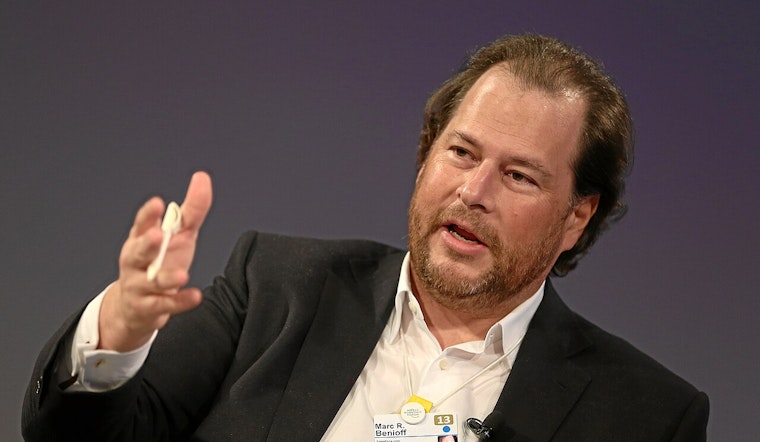
After a week of intense backlash and even losing a longtime ally, Salesforce CEO Marc Benioff has issued a full apology for suggesting President Donald Trump should deploy National Guard troops to San Francisco—but the reversal comes amid fresh revelations about his company's proposals to assist federal immigration enforcement operations.
"Having listened closely to my fellow San Franciscans and our local officials, and after the largest and safest Dreamforce in our history, I do not believe the National Guard is needed to address safety in San Francisco," Benioff posted on X on Friday, October 17th. "My earlier comment came from an abundance of caution around the event, and I sincerely apologize for the concern it caused."
Having listened closely to my fellow San Franciscans and our local officials, and after the largest and safest Dreamforce in our history, I do not believe the National Guard is needed to address safety in San Francisco. My earlier comment came from an abundance of caution around… pic.twitter.com/7TRdTu7hdq
— Marc Benioff (@Benioff) October 17, 2025
The retraction caps a tumultuous week for the billionaire tech executive, who sparked outrage when he told The New York Times in an interview from his private jet that he "fully supported" Trump and welcomed the idea of federal troops patrolling San Francisco streets. According to reporting from Hoodline, Benioff's remarks drew sharp rebukes from local officials who viewed them as both an insult to law enforcement and a dangerous invitation to federal overreach.
A Friendship Fractured
The controversy reached a breaking point when longtime friend and Silicon Valley investor Ron Conway resigned from the Salesforce Foundation board on Thursday after serving for over a decade. "It saddens me immensely to say that with your recent comments, and failure to understand their impact, I now barely recognize the person I have so long admired," Conway wrote in a scathing email to Benioff obtained by multiple outlets.
Conway, known as the "Godfather of Silicon Valley" for his early investments in Google and Airbnb, pulled no punches. According to The San Francisco Chronicle, he criticized Benioff's "obsession with and constant annual threats to move Dreamforce to Las Vegas," noting ironically that Las Vegas has a higher violent crime rate than San Francisco.
Philanthropy as Performance Art
While Benioff was dealing with Conway's resignation, another billionaire weighed in with a different kind of criticism. Laurene Powell Jobs, founder of Emerson Collective and widow of Steve Jobs, published a scathing essay in The Wall Street Journal Friday that took aim at what she called Benioff's transactional approach to giving—without ever naming him directly. "We are living in a moment when giving is too often used not to serve but to control—to decide what matters and which rules should apply," Powell Jobs wrote, invoking the 800-year-old wisdom of Maimonides about charity that restores dignity rather than diminishing it.
The essay zeroed in on Benioff's comment to The Standard: "If there is anyone who's doing more for the local community, I want their name, because I'm very competitive." According to The Standard, Powell Jobs called this attitude "quiet corruption corroding modern philanthropy"—where donations become leverage to dictate policy rather than genuine civic participation. "In his eyes, generosity is an auction—and policy is the prize awarded to the highest bidder," she wrote. "That's the quiet corruption corroding modern philanthropy: the ability to give as a license to impose one's will. It's a kind of moral laundering, where so-called benevolence masks self-interest."
The ICE Software Proposals
Just as the dust was settling from the National Guard controversy, another bombshell dropped. Internal documents obtained by The New York Times revealed that Salesforce had pitched Immigration and Customs Enforcement on using the company's AI technology to help recruit 10,000 new officers and enhance deportation operations. According to The Chronicle, the materials included a five-page memo, spreadsheets outlining collaboration opportunities, and slides exploring how AI could process tip-line data and investigations.
While Salesforce has worked with ICE under previous administrations, according to Washington Examiner, this proposal to actively expand the agency's enforcement capacity marked a significant shift. The timing couldn't be worse for a CEO already facing accusations of abandoning progressive values—particularly in a sanctuary city where such partnerships are deeply controversial.
Local Officials Push Back
San Francisco Supervisor Matt Dorsey, whose District 6 includes the Moscone Center area, didn't hold back his initial disappointment. "This is a slap in the face to San Francisco," Dorsey said after Benioff's original comments. "It's insulting to our cops, and it's honestly galling to those of us who've been fighting hard over the last few years to fully staff our SFPD."
District Attorney Brooke Jenkins was even more direct. "To invite chaos into our city, no, Mr. Benioff needs to know that's not the solution," Jenkins told KGO-TV. "And I want the president to know we don't want his version of law and order."
Mayor Daniel Lurie walked a careful line, emphasizing the city's safety improvements without directly attacking Benioff. According to KQED, crime is down nearly 30% citywide, and for the first time in years, the city is seeing net gains in both police officers and sheriff's deputies.
The Dreamforce Drama
The controversy overshadowed what should have been a triumphant week for Salesforce. Dreamforce, held at the Moscone Center at 747 Howard Street, brought roughly 45,000 attendees to the city. According to The San Francisco Examiner, protesters gathered outside the conference on Tuesday, with activist Michael Petrelis calling Benioff's initial proposal "fascism" that "you can't sugarcoat."
Benioff largely avoided the controversy during his keynote address, focusing instead on the company's new AI-powered Agentforce product. But the fallout was impossible to ignore—comedians Kumail Nanjiani and Ilana Glazer canceled their scheduled performances at Dreamforce, citing "unforeseen circumstances."
A Pattern of Political Evolution
The controversy marks a stunning political evolution for Benioff, who once championed progressive causes and hosted fundraisers for Hillary Clinton. As Mission Local noted, the 61-year-old billionaire has been "bleating endlessly" about San Francisco defunding its police—a claim that's demonstrably false, according to multiple mayors and budget records.
According to TechCrunch, at the end of his controversial Times interview, Benioff reportedly asked his shocked PR person, "Too spicy?" The answer, it turns out, was a resounding yes.
Benioff's retreat comes as President Trump has already deployed National Guard troops to Los Angeles, Chicago, and Portland, with legal experts questioning the constitutionality of such deployments. Mayor Lurie responded to Benioff's Friday apology by posting on X: "Dreamforce brought more than 45,000 people into San Francisco, and it was a public safety success. This didn't happen by accident."
Why This Article Is Being Written Now
This article is being written today, October 19th, two days after Benioff's full apology, because the story continues to evolve with new revelations about Salesforce's ICE proposals and ongoing questions about the company's relationship with federal enforcement agencies. The juxtaposition of Benioff's National Guard retraction with reports of his company's deportation-enhancement proposals raises broader questions about corporate ethics and San Francisco values that deserve deeper examination.





