

























































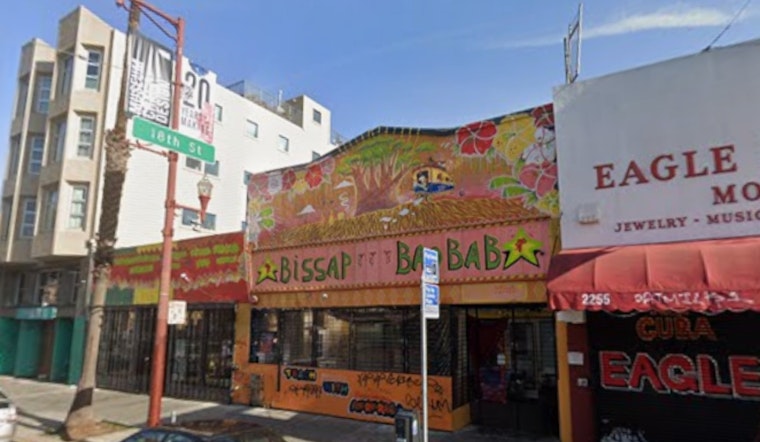
After 28 years of bringing West African rhythms and flavors to San Francisco's Mission District, Bissap Baobab is closing its doors once more — but owner Marco Senghor swears this isn't the end of the story.
The beloved Senegalese restaurant and dance hall at 2243 Mission Street will serve its last plate of ceebu jen on December 28, marking the latest chapter in a saga that has seen the establishment weather dot-com busts, pandemic closures, immigration prosecutions, and neighbor disputes with the tenacity of its namesake tree. The announcement came Monday via Instagram, where Senghor described the decision as "incredibly emotional" and cited the difficulty of sustaining such a large space in current times.
"These walls have witnessed weddings, birthdays, revolutions, breakups, makeups, miracles, and thousands of nights where cultures blended like spices in a Ceebu Jen pot," Senghor wrote, capturing the essence of what made this place more than just another restaurant closure in a city that's seen too many.
A Farewell Party, Not a Funeral
The restaurant is planning to go out with style, hosting a farewell party on December 20 that promises to embody everything Bissap Baobab has meant to the community. All scheduled events will continue until the final night, giving patrons multiple chances to say goodbye. But in typical Senghor fashion, this closure is paired with immediate resurrection plans.
Starting December 1, Bissap Baobab will host weekly "Baobab Flying Night" gatherings every Saturday at Muddy Waters Coffee & Lounge at 521 Valencia Street. The intimate, 49-seat capacity events require advance reservations through Eventbrite, with $35 tickets covering a traditional meal of ceebu jen (jollof rice), pastelles (African empanadas), and a bissap or ginger drink. Walk-ins can still grab Afro wraps, crêpes, and coffee in what Senghor describes as a "cozy Petit Maquis ambiance."
The move to Muddy Waters isn't just a temporary solution — according to recent reports, Senghor is in negotiations to purchase the 35-year-old Valencia Street café outright. It's a development that would bring his West African cultural hub back to its roots on Valencia, where many longtime Mission residents remember the original Little Baobab.
Legacy Business, Persistent Challenges
The irony isn't lost on anyone that Bissap Baobab was added to San Francisco's Legacy Business Registry on July 22, 2024 — a designation meant to help preserve the city's cultural touchstones. The program, which now includes more than 400 businesses, provides recognition and some financial support, but clearly wasn't enough to overcome the mounting challenges of operating a large entertainment venue in today's San Francisco.
The current location has been a battlefield since day one. After reopening in the former Lupulandia Brewery space in 2022, Senghor faced immediate opposition from condo neighbors who filed noise complaints despite his spending $80,000 on soundproofing. The venue endured a grueling 10-month ordeal before finally securing its beer and wine license in mid-2023 — a process that typically takes 60 days.
Senghor later told reporters that during the first year at the new location, he lost managers and employees and struggled to attract customers without hard liquor, nearly handing the keys back to his landlord before the full license came through. When he finally received approval to serve alcohol until 2 a.m. daily earlier this year, it seemed like things might turn around.
A History of Resilience and Setbacks
Understanding Bissap Baobab's latest closure requires understanding Marco Senghor's extraordinary journey. The Senegalese-born entrepreneur opened his first Little Baobab in 1996, when the neighborhood was what he called a "war zone" riddled with prostitution and gangs. Something "magic" happened in 1998 when Spearhead's Michael Franti recorded his album "Live at the Baobab" there, catapulting the restaurant to worldwide fame.
At his peak, Senghor owned seven businesses across the Bay Area. But everything changed in 2018 when he was arrested and charged with obtaining U.S. citizenship through a fraudulent marriage. Senghor ultimately pleaded guilty to making a false statement on an immigration document, receiving one year of probation and a $1,000 fine in 2019, avoiding a potential 10-year prison sentence.
The legal battle's aftermath proved devastating. His felony conviction made him ineligible for federal loans and assistance, including the PPP loans that helped many businesses survive the pandemic. He sold the original Bissap Baobab building for over $2 million to pay legal fees, closed his Oakland location, and kept only Little Baobab running with irregular hours.
Mission District's Cultural Crossroads
Bissap Baobab's struggles reflect broader tensions in the Mission District, where longtime cultural institutions increasingly clash with newer residents and changing demographics. When Senghor reopened in 2022, he received support from everyone from local politicians to the preschool next door, yet faced persistent opposition from a handful of condo owners.
The neighborhood itself is in flux. While Mission Street between 14th and 30th streets has 70 commercial vacancies, certain cultural corridors like 24th Street's Calle 24 maintain lower vacancy rates than before the pandemic. The disparity highlights how different parts of the Mission are experiencing vastly different economic realities.
What makes Bissap Baobab's situation particularly poignant is its role as one of the Bay Area's only West African restaurants, filling a cultural void in a region where East African cuisines have at least some presence. Its closure leaves a gap that can't simply be filled by another restaurant — it removes a cultural bridge that brought together diverse communities through music, food, and dance.
The Baobab Bends But Doesn't Break
Senghor's Instagram message ended with characteristic defiance: "The Baobab will rise again. We are searching, listening, and trusting that the Universe is already whispering our next address. Wherever we land, the drums will follow — and so will the Ceebu Jen."
For a business that has already survived immigration raids, fires, legal battles, pandemic closures, and neighborhood opposition, betting against its resurrection seems foolish. The Saturday gatherings at Muddy Waters represent more than a temporary solution — they're a testament to a community's refusal to let go of something essential to its identity.
As one regular told Mission Local during previous struggles: "Baobab is more than an entertainment spot. It's a hub for community, support, and growth."
Whether at 521 Valencia or some future location yet to be revealed, the smart money says the drums will indeed follow Marco Senghor wherever he lands next. After 28 years of bending without breaking, the baobab tree's roots in San Francisco soil run too deep to simply disappear.





