

























































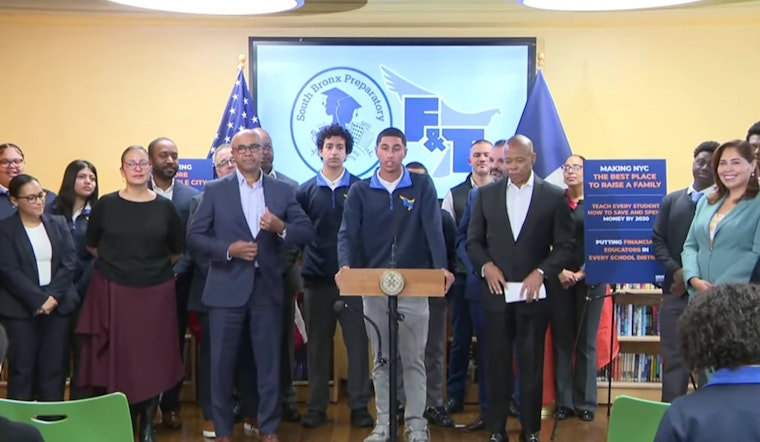
Breaking new ground in financial education, New York City Mayor Eric Adams, in collaboration with the Department of Consumer and Worker Protection (DCWP) and New York City Public Schools, has launched an in-school banking pilot program as part of its broader "Financial Literacy for Youth" initiative. Announced yesterday, the ground-breaking program is slated to kick off in 2026, aiming to introduce banking services directly into public schools to help students learn how to manage their finances effectively, according to a press release from the Office of the Mayor.
This financial empowerment strategy targets a gap in financial literacy, particularly in communities with higher than average unbanked rates, and Mayor Adams is quoted as stressing the importance of teaching students how to save and spend money, "If you don't teach people how to use their money, they will lose their money. That's why our administration launched a landmark initiative to make sure every public school student can learn how to save and spend money by 2030," he said the program not only delivers basic banking services but also opens the door for hands-on experience and career development opportunities in the financial sector for these young minds, as per the Office of the Mayor. In addition to personal finance workshops, these services aim to decrease the reliance on costly alternatives like check cashers that can exacerbate cycles of poverty.
The initiative is already gaining support from a dozen financial institutions including Bank of America, Brooklyn Credit Union, and Citizens Bank among others, these partners will contribute to the in-school banking services offering students and their families safer, more affordable banking options. "Financial literacy is a lifelong skill that empowers students to make confident, informed choices about their futures," New York City Public Schools Chancellor Melissa Aviles-Ramos told the Office of the Mayor, emphasizing the transformative potential of such initiatives when integrated within the educational framework. The plan is to eventually employ financial educators across all school districts to enhance the understanding of personal finances among students.
The DCWP has already helped New Yorkers save over $5 million through financial counseling; the in-school banking pilot will further serve more than 350,000 public school students and their families over the first five years of implementation, DCWP Commissioner Vilda Vera Mayuga highlighted her personal connection to this mission, "From my own struggles to become more financially stable earlier in life to raising two growing children today, I know first-hand how important it is to learn about personal finances; that is why Financial Literacy for Youth is so near and dear to my heart," she conveyed to the Office of the Mayor. Her comments underscore the program's evident commitment to building a financially savvy future generation.
Furthermore, research from DCWP suggests that students with access to savings accounts are more likely to attend college, signaling a positive correlation between financial education and academic success, besides these educational outcomes the program's alignment with the Community Reinvestment Act indicates that financial institutions may also benefit from investing in community development through this channel. Advocates of the program, such as Bronx Borough President Vanessa L. Gibson, praise the collective efforts in the Office of the Mayor release, "I commend Mayor Adams, Chancellor Aviles-Ramos, Commissioner Mayuga, and the participating financial institutions for investing in our students’ futures and ensuring they have a strong financial foundation."





