

























































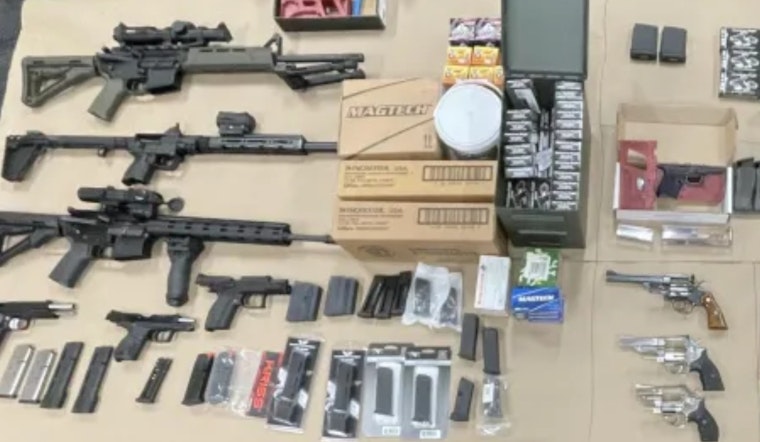
What started with a 9-year-old chasing down a runaway ball on a quiet Berkeley block ended with police hauling away a small arsenal and slapping a neighbor with weapons and threat allegations, according to authorities.
Berkeley police say they arrested 54-year-old Michael Aschoff on a warrant Monday evening and found a loaded handgun tucked into his waistband. Officers then searched his home in the 1600 block of Cornell Avenue, where they say they seized nine firearms in all, including an AR-pistol-style rifle, a shotgun, and several handguns. Aschoff is now facing multiple alleged weapons and criminal-threat violations. Police say he has already posted bail and is not currently in custody.
What happened in the neighborhood
According to police, the trouble began last Thursday when a 9-year-old boy stepped onto Aschoff’s property to retrieve a ball that had gone over the line. Later that same day, Aschoff allegedly emailed the child’s family’s landlord to declare that “no one was allowed on his property under any circumstances” and to threaten that he would shoot anyone who came onto it, Berkeley police told The Berkeley Scanner.
Officers went to speak with Aschoff about the email. The department later described that exchange as a poor conversation and said it prompted them to seek a gun-violence restraining order, along with warrants tied to the alleged threats. Police say the follow-up arrest turned up the loaded handgun on Aschoff, and the subsequent search of his home uncovered the full set of nine firearms.
How California's "red-flag" orders work
California’s gun-violence restraining orders, often called red-flag orders, are designed for situations where someone appears to pose an immediate risk of gun violence. In those cases, officers can ask a judge for a short emergency order that temporarily blocks the person from accessing guns while the court schedules a hearing. After that, longer orders running from one to five years are possible, but only after the person receives notice and has a chance to appear in court.
Court decisions and legal summaries explain that emergency GVROs can be issued relatively quickly based on a lower showing of danger, while any longer-term order requires proof by clear and convincing evidence. Those longer orders cut off the person’s legal access to firearms for the entire period they are in effect. As outlined in case law and statutory summaries, GVROs are civil tools that aim to prevent imminent harm while still putting the process under a judge’s supervision, according to Justia.
Local policing context
This is not the first time Berkeley officers have followed a threat or shooting tip straight to a weapons cache. The department has in recent years used search warrants and investigative tools to track down guns in other cases involving alleged threats and gunfire. In one prior incident, officers recovered multiple firearms linked to a shooting investigation, illustrating how police can move from a single reported threat or lead to full-blown searches and seizures, Berkeleyside reported.
Legal implications for the charges
Berkeley police say Aschoff is being investigated on suspicion of criminal threats along with several weapons-related offenses. Under California law, criminal-threat charges under Penal Code section 422 can be filed as either a misdemeanor or a felony, depending on the circumstances, and can carry possible jail or state prison time, according to California Penal Code §422.
State law also restricts possession of large-capacity magazines and certain assault weapons. Violations can be treated as infractions, misdemeanors or felonies depending on the conduct, as outlined in Penal Code §32310. Carrying a concealed, loaded firearm and unlawfully possessing an assault weapon are separate crimes with their own penalty structures, summarized by Shouse Law on PC 30605 and its PC 25400 summaries.
As of publication, police said Aschoff’s first court date was not yet available. The Berkeley Scanner reported that he had posted bail and was no longer in custody.



