

























































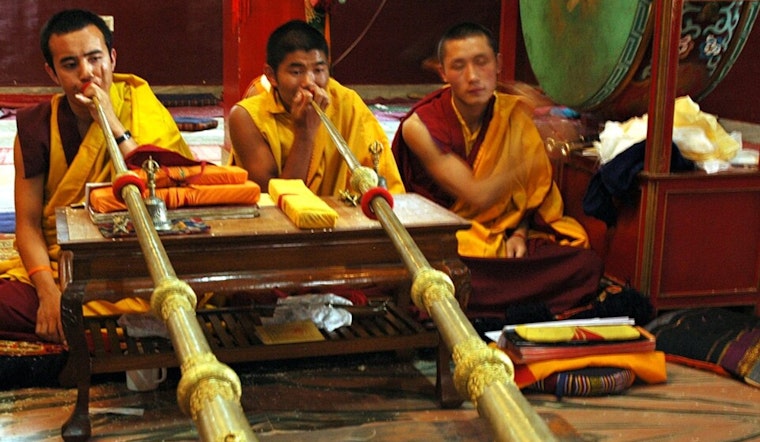
Tibetan Buddhist monks from Gaden Shartse Monastery in India closed out a weeklong North County visit on Saturday with a quiet showstopper at PHES Gallery in Carlsbad, carefully dismantling a four-day sand mandala they had built by hand. The ritual, part prayer and part performance, drew visitors who watched the monks sweep vivid bands of sand toward the center before preparing to return the blessed grains to the ocean. Throughout the week, the visit folded together public teachings, hands-on workshops and a small marketplace that helped raise donations for the monastery's schools and care programs.
According to PHES Gallery, the visiting group consecrated a “Peace Sand Mandala” midweek and opened the studio so people could drop in as the design took shape. Event listings described the mandala as built grain by grain over four days by six lineage-trained monks, with a formal dissolution ceremony on Saturday. AllEvents and the gallery calendar gave the public multiple windows to watch the patient work unfold.
Tour Dates, Teachings And Fundraising
Organizers said proceeds from the Carlsbad stop support the monastery and its students, and Eventbrite notes that donations go toward the roughly 1,700 monks who live and study at Gaden Shartse. During the week, the visiting teachers also led a chanting and empowerment event in Vista, part of a string of North County appearances that mixed ritual art, public talks and smaller workshops. One of those evening programs appeared on the calendar at CommuniTea.
Geshe Phuntsho, one of the visiting teachers, told Fox5 San Diego that “Buddhism is not a religion, it is a way of life,” and said he has been bringing teachings to the region for about 25 years. The monks described the mandala’s final sweeping as both a blessing and a pointed reminder to loosen attachment while holding compassion for the wider world.
About Gaden Shartse Monastery
Gaden Shartse Monastic University was re-established in Mundgod, Karnataka, in the late 1960s after monks fled Tibet and it remains a center for Gelugpa study and ritual practice, according to the monastery's official history. Gaden Shartse traces its reconstruction to a small group of refugee monks, while tour materials and supporting organizations describe a much larger community today, with some listings putting the number of resident students, teachers and practitioners at more than 1,600 to 1,700. For context, the tour's promotional pages and organizers use the larger figure to reflect the full monastic community and supporting staff, and Sacred Arts tour materials publish that higher estimate.
Sand Mandala: Craft, Meaning And The Dissolution
Sand mandalas are created with tiny metal funnels known as chakpurs, which monks use to tap out streams of colored sand into an intricate cosmic diagram. Their deliberate dismantling is treated as a direct teaching on anicca, or impermanence, as scholars and museum programs explain. As the design is swept away, some of the blessed sand is handed to participants, and the rest is traditionally returned to a body of water as a prayer or blessing for the world, a practice documented by institutions that have hosted mandala demonstrations. For more on the ritual and its symbolism, Smithsonian Folklife and the National Endowment for the Arts' profile of mandala artist Losang Samten offer additional background on the technique and imagery.
Local arts supporters say the visits give San Diego County residents rare firsthand access to an esoteric tradition while helping cover the monastery's needs. The PHES Gallery's owners, Paul and Ellen Speert, have hosted and supported Gaden Shartse's visits for years, the gallery notes, and Fox5 San Diego reported that Ellen Speert has helped the monastery for roughly 25 years. Organizers said that blend of teaching, cultural exchange and fundraising sits at the heart of the group's U.S. tours.
How Locals Could Take Part
The PHES event offered free public viewing, with optional workshops and a suggested donation for special programming. Eventbrite listed a suggested 20 dollar contribution for parts of the program. Organizers invited people not only to watch the mandala's creation but also to join in the final sweeping as a symbolic act, and the remaining blessed sand was scheduled to be poured into the Pacific as an offering for peace and healing.





