

























































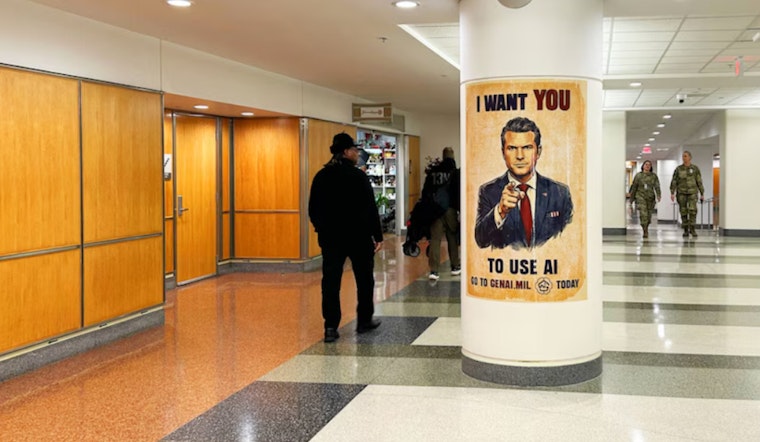
Earlier this week, the War Department announced the launch of its new artificial intelligence tool, GenAI.mil, aimed at revolutionizing the United States military's operational capabilities. GenAI.mil, adapted from Google's AI tool Gemini and rebranded as Gemini for Government, is designed to manage controlled unclassified information securely. "The future of American warfare is AI, and the U.S. military will not be behind," Pentagon Press Secretary Kingsley Wilson stated in the department's Weekly Sitrep video, according to the U.S. Department of War.
The tool, which Secretary of War Pete Hegseth introduced, is expected to assist with document writing, answering queries, and deep research. Hegseth advised all department members to "I expect every member of the department to log in, learn it and incorporate it into your workflows immediately." This integration of AI is in line with President Trump's vision of consolidating U.S. dominance in global artificial intelligence, aiming to expedite efforts and give U.S. services an advantage over adversaries. Moreover, this technological advance is part of the Trump administration's America First agenda and seeks to reassert the historical ethos of peace through strength, at a juncture when the global theater seems as unpredictable as ever.
In addition, the War Department has been deepening ties with Australia, with discussions on defense and rare minerals held during the 40th Australia-United States Ministerial Consultations. Earlier in December, Secretary Hegseth and Secretary of State Marco Rubio met with Australian counterparts, focusing on defense cooperation and the AUKUS agreement, which promises to yield new nuclear-powered submarines for Australia. A subsequent trilateral meeting with U.K. Defense Secretary John Healey further emphasized the importance of infrastructure and workforce to support this international defense agreement. "In line with the shared intent to move 'full steam ahead' on [the Australia, U.K. and U.S. trilateral security agreement], the principals recognized the work underway to deliver priority infrastructure and workforce uplift in support of an enhanced trilateral submarine industrial base," Wilson noted in the U.S. Department of War.
The collaboration with Australia forms a significant piece of the U.S. defense strategy, one that involves the complex dance of diplomacy and military might. As the AUKUS deal accelerates, it aims not only to strengthen military power but also to bolster the defense industrial base. The United States will sell three Virginia-class submarines to Australia, expected to be delivered in the 2030s. In conjunction, all three AUKUS nations are developing the SSN-AUKUS, slated for operational readiness in the U.K. by the 2030s and Australia by the 2040s—underscoring a long-term commitment to shared military advancement among the allies.
Domestically, the Interior Department has partnered with the U.S. Department of War to transfer jurisdiction of roughly 760 acres of California public land to the Department of the Navy. This transfer is to support border security operations by establishing a fifth national defense area, where the Navy will have administrative authority, and personnel stationed there will have greater authority in executing their mission. This strategic move falls under efforts to enforce border security, a contentious point in the national debate, and further reflects the administration's broader security agenda.
Hegseth also joined a ground-breaking ceremony at Redstone Arsenal in Huntsville, Alabama, marking the relocation of U.S. Space Command headquarters. This relocation is part of a larger initiative to rebuild the American defense industrial base, and it is projected to create over 30,000 jobs in the state. President Trump had previously emphasized that Spacecom will be crucial in developing the Golden Dome for America's missile defense system, thus contributing to the nation's military and economic strength simultaneously.
The broad sweep of actions this week, from the introduction of GenAI.mil to the engagement with international partners and domestic military developments, aligns closely with the president's directive for American defense—an approach characterized by technological innovation, strategic partnerships, and homeland security enhancements. Hegseth emphasized this comprehensive strategy, saying, "We are defending the homeland in the hemisphere, we're deterring adversaries, we’re working with our allies to burden share and shift those burdens, we’re looking at rebuilding the defense industrial base — which is what we are doing here — we’re reviving the warrior ethos, rebuilding the military and reestablishing deterrence," underscoring the multifaceted efforts to maintain and further America’s defensive capabilities.




