

























































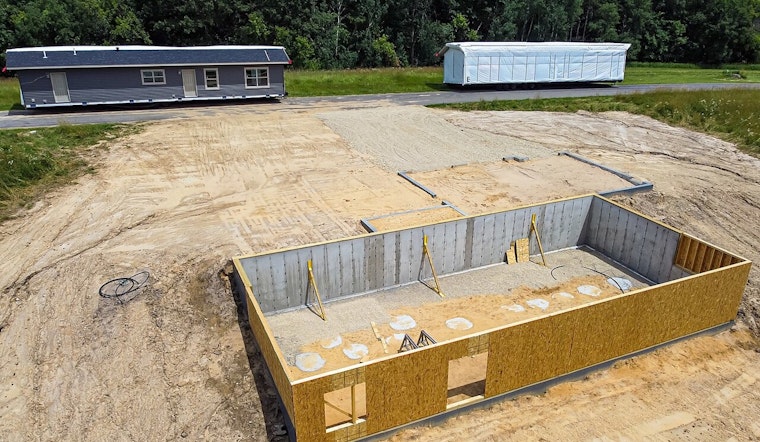
Altadena got a very visible sign of wildfire recovery on Thursday when a factory-built modular home rolled onto a residential lot, then rose into place by crane. It is the first house delivered through the Steadfast LA and Samara partnership created after the Eaton Fire, and it is earmarked for the Rodriguez family. The two-bedroom, two-bath home is being installed in three volumetric sections; crews set the first piece on Thursday and expect to finish the remaining site work and utility connections in the coming weeks.
In a press release, Samara said the installation landed just 34 days after permits were approved on December 19, 2025. Foundation work started the following day, with the factory-built sections later craned into place. The company says it is providing its Backyard XL models at cost and that the program will deliver homes at no charge to eligible wildfire survivors. According to the release, families are expected to move in a few weeks after the final site work is complete.
Samara CEO Mike McNamara described the units as both fire-resistant and highly sustainable, noting that they can generate their own energy and that the HVAC system is designed to filter wildfire smoke. “We're just super excited, we're going to get the Rodriguez family back into their home and into their community,” McNamara said, as reported by CBS Los Angeles.
What the Homes Look Like and How Many Are Coming
Local reports describe the Rodriguez home as roughly 950 square feet, shipped up from a factory in Mexicali before being lifted onto its new foundation in Altadena. According to Pasadena Now, Samara’s Backyard XL models come as two-bedroom, two-bath homes that, once you factor in permitting and site preparation, run about $450,000 to $500,000 per installation. Steadfast LA has said it plans to roll out dozens more of these units across fire-affected neighborhoods through 2026.
Steadfast LA is leaning on a network of nonprofit and industry partners to identify and support recipients. HomeAid OCLA says it will guide eligible candidates through the process, while loanDepot and Armanino Advisory LLC help confirm financial need and manage applications. Program materials say applicants generally must have lost their primary residence in the January 2025 fires and be uninsured or underinsured to qualify. The foundation has also indicated that long-time residents and those showing clear financial hardship will be prioritized.
Why Modular Is Front and Center in the Rebuild
Partners backing the effort say modular construction is a way to cut the long waits that often follow major fires. Building in factories reduces strain on local labor and materials, which are typically stretched thin after a disaster. Reporting in the Los Angeles Times has highlighted both the speed advantages of prefabricated designs and the unease some residents feel about moving into a home built off-site. For many survivors, officials say, the tradeoff is straightforward: get back on their property sooner or wait years for traditional construction.
Rick Caruso, chair of Steadfast LA, stood alongside county and local officials at Thursday’s installation and underscored how personal the milestone is for the first recipient. “Rosalina lived in this community with her family for 37 years,” he said, adding that she should be able to return “in a couple of weeks,” according to CBS Los Angeles. Officials framed the new house as one visible step in what is expected to be a long recovery from the January 2025 blaze.
Organizers say installations are set to continue through 2026 as crews secure additional sites and permits. Homeowners interested in the program can find screening criteria and application details on the foundation’s website. Per Steadfast LA, grant recipients must show financial need and have a suitable lot that can accommodate a modular home, with the broader goal of keeping long-time residents in their neighborhoods while rebuilding moves faster than it would under traditional construction timelines.




