

























































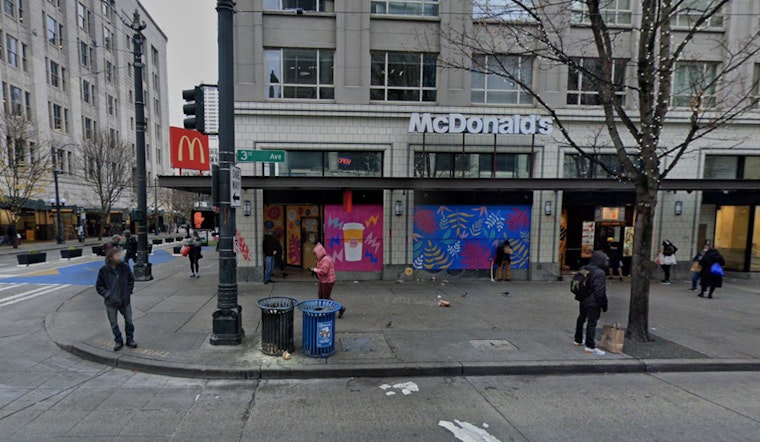
At the McDonald's on the corner of Third Avenue and Pine Street in downtown Seattle, the dining room is essentially off-limits. The double doors are covered in plywood, customers stay on the sidewalk, and staff now pass food through a narrow plexiglass slot instead of welcoming people inside. Workers and nearby employees say the fortified setup is the result of years of street fights, open drug use, and repeated assaults along the Pike/Pine stretch.
As reported by The Independent, the restaurant's doors remain boarded, and a makeshift transaction hatch has replaced the public entrance. Staff and locals told reporters the change traces back to pandemic-era closures and a January 2020 shooting, after which the dining room never reopened to customers. The Independent noted that its story relied in part on a visit documented by the Daily Mail, which photographed the plywood exterior and small plexiglass window and relayed interviews with employees and neighbors.
One man who said he previously used drugs in the area told reporters he "watched a girl get shot and killed right here," according to The Independent. A worker described seeing assaults play out on the sidewalk outside the restaurant. Neighbors and regulars interviewed by the outlet said the corner has picked up a dark nickname, "McStabby's," a reference to how often violent incidents seem to cluster around the storefront.
Numbers and city response
Seattle Police Department data and mapping tools give residents a way to pull up recent reports and confirm that certain downtown blocks carry a disproportionate share of violent and property crimes. The department maintains an online crime-data portal for neighborhood-level lookups; Seattle Police Department maps provide daily updated offense information, and city officials have pointed to targeted technology and patrol shifts for high-traffic corridors.
The mayor’s office has highlighted the city’s Real Time Crime Center as one of the tools meant to help investigate and deter incidents along Third Avenue and other hot spots, saying the center has aided hundreds of investigations since it launched. According to the mayor's office, the center integrates cameras and data feeds in an effort to improve response times and case work in busy areas.
Locals split on safety and scene
Reactions from Seattleites are all over the map. Some regulars and downtown workers posting online say the hatch-only service and closed lobby make them feel safer, especially during late-night hours. Others argue that the boarded-up facade has become a kind of billboard for the city’s unresolved struggles with public safety, visible drug use and homelessness in the core of downtown.
Social media posts and discussion boards capture that back-and-forth in real time. Commenters trading stories on Reddit describe everything from uneventful coffee runs to unnerving encounters outside the restaurant. Longtime reviewers on travel sites have for years flagged the Third-and-Pine intersection as one of the rougher patches of central Seattle, and a business listing for the restaurant at Tripadvisor reflects a wide range of customer experiences.
What officials and outlets reported
News outlets covering the boarded-up McDonald's noted that they asked both the Seattle Police Department and McDonald’s for comment on the shift to hatch-only service at the downtown location. A national republishing of The Independent's piece said the same: reporters reached out to local authorities and corporate representatives and were waiting to hear back.
AOL picked up and reproduced the core details from The Independent’s reporting, including the description of the plywood-covered doors, the plexiglass hatch, and the timeline that ties the permanent lobby closure to the 2020 shooting and subsequent pandemic period, while also noting the requests for official reaction.
For now, the Third-and-Pine McDonald’s is still open for walk-up customers who are willing to order through the slot in the wall. It is not yet clear whether the boarded dining room is a long-term business decision or a temporary step to protect staff. In the meantime, the fortified burger counter has become another flashpoint in Seattle’s ongoing argument over downtown policing, public health and social services. Customers who would rather skip the corner have alternatives in other downtown locations, delivery services or drive-thru options while the debate continues just outside the plywood.



