

























































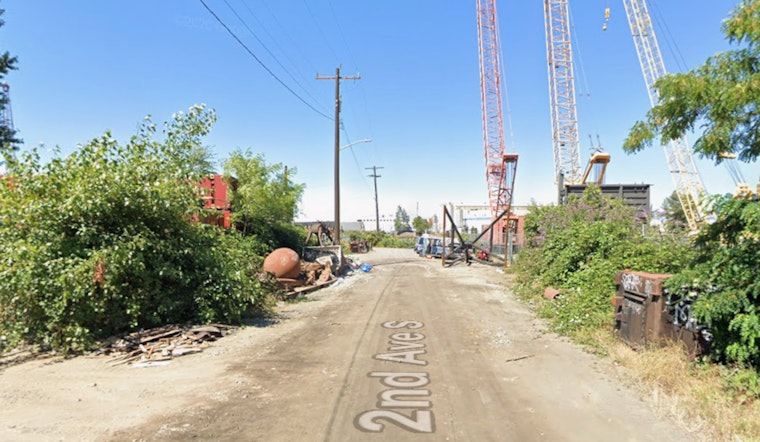
A long-empty, state-owned lot in southeast West Seattle might finally be getting put to use. The former WSDOT “Glassyard” parcel is in early planning as a temporary transitional housing site that would pair roughly 20 tiny houses with a controlled lot for about 72 RVs. On paper, that footprint could shelter close to 100 people. For now, it is just a concept drawing at the permit stage, and any actual opening would still need multiple city and state approvals.
What the site plan shows
The concept site plan, dated Jan. 16, 2026, lists the owner as the State of Washington and sketches out 20 tiny houses, parking for up to 72 RVs, and space for hygiene, laundry, and kitchen trailers across roughly 3.9 acres, according to the concept site plan. The file also includes detailed fire-safety notes, including a requirement that RVs be drained of gas and oil before they are hooked up, and a limit that all tiny-house structures stay under 120 square feet. The drawing functions as an early permit concept rather than a finished application.
Who would run it
The drawings carry the Low Income Housing Institute’s name. LIHI already operates Camp Second Chance and several other permitted tiny-house villages in Seattle, where it provides on-site case management and hygiene facilities. As described by the Low Income Housing Institute, those villages are staffed and structured with programs designed to move residents into permanent housing. The nonprofit has also run safe-parking and temporary shelter programs that connect people with case managers and support services.
Why it's happening now
The timing lines up with Mayor Katie Wilson’s push to speed up shelter creation. Her January executive order directs an interdepartmental team to scout city and other public lands that could host emergency shelter and to streamline the permitting that goes with it. The directive spells out that the city is hunting for public sites and trying to cut approval timelines, according to the Mayor's Office. Any project on this WSDOT parcel would still need coordination with the state landowner and other partners.
What's in the plan
The concept paperwork sketches out operations in broad strokes. All tiny houses and common-area structures would be under 120 square feet, the site would be limited to residents and staff, and trailers for hygiene, laundry, and food service would connect to new water and sewer branch lines. The materials also outline fire-safety measures and required spacing for both RVs and tiny homes. Local reporting by KING 5 first surfaced the filing and its preliminary status.
Approvals and next steps
The concept filing is only an opening move. It would need to be followed by permitting, any required environmental review, and public outreach before anyone moves in. The Seattle Department of Construction and Inspections explains the research and permitting steps that come before a new development or change of use, according to the Seattle Department of Construction and Inspections. Because the land belongs to WSDOT, state concurrence and interagency agreements would also be part of the process.
Neighbors and advocates are expected to watch the permitting closely. Similar LIHI villages have relied on community advisory committees and Good Neighbor Agreements to manage impacts, according to LIHI. For now, the site plan is only an early marker in what could be a long road, but it gives the city a concrete example of how public land in West Seattle might be used to add shelter capacity.





