

























































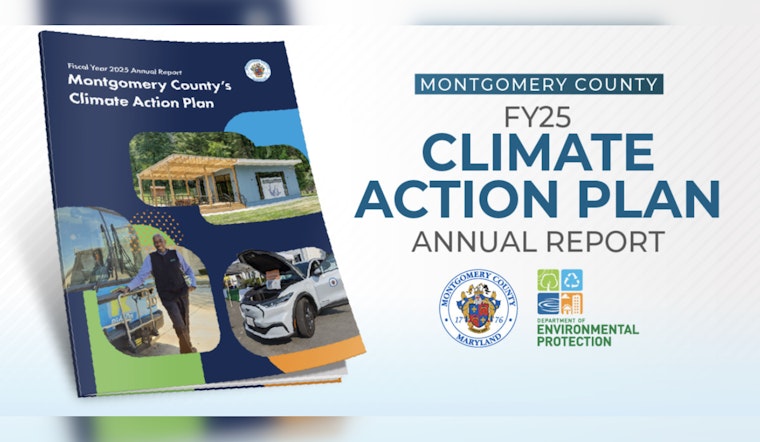
Montgomery County, led by County Executive Marc Elrich and County Council President Natali Fani-González, has reported significant progress in its Climate Action Plan (CAP). The Fiscal Year 2025 Annual Report highlights the county’s efforts in sustainability and resilience, outlining initiatives that address environmental justice and the effects of a changing climate, according to the county's release.
Eighty of the 84 actions outlined in the Climate Action Plan have been initiated, with 63 either completed, in progress, or incorporated into government operations. The initiatives focus on clean energy, sustainability, transit solutions, and flood response. Notable achievements include zero-fare transit on the Ride On bus service and the addition of electric and hybrid vehicles to the county fleet, with a target of a zero-emission bus system by 2035.
Progress in building sustainability includes the completion of the 6th District police station’s microgrid and the start of construction on Burtonsville Elementary School, the county’s first Net Zero school. Additional green infrastructure improvements feature the installation of three Mesonet weather stations, providing real-time data on weather conditions to support emergency management in partnership with the University of Maryland and the Maryland Department of Emergency Management.
Progress under the Climate Action Plan also includes environmental initiatives, with Tree Montgomery planting over 5,000 trees during the fiscal year. The Montgomery County Green Bank has supported the development of 19.5 megawatts of clean energy, contributing to reduced carbon emissions. Additionally, the county has installed 40 flood sensors, complemented by solar-powered Mesonet weather stations, to enhance monitoring and preparedness for severe weather, according to Sarah Kogel-Smucker, the County’s Climate Change Officer.
The Fiscal Year 2025 Annual Report, covering activities from July 1, 2024, to June 30, 2025, details Montgomery County’s approach to climate action, including clean energy, efficient buildings, and improved transportation systems, with environmental equity and social justice incorporated throughout. Dr. Sumant Nigam of the University of Maryland highlighted the role of the Maryland Mesonet in enhancing understanding of climate patterns and supporting disaster response. The county has also secured over $58 million in climate-related grants to support current initiatives and future sustainability and resilience efforts.





