

























































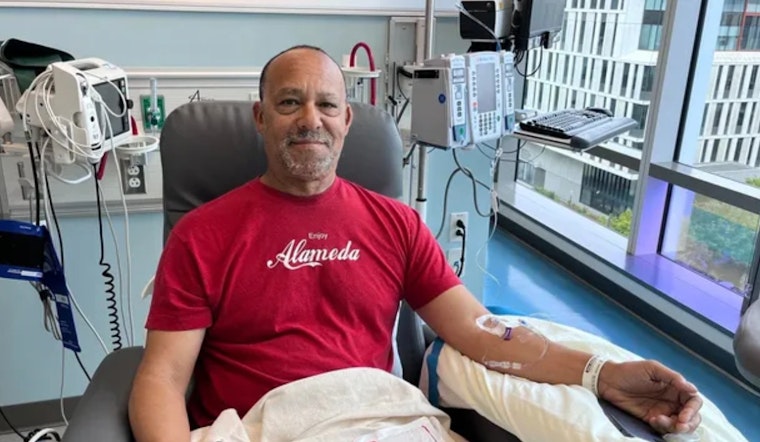
A 70-year-old retired San Francisco firefighter battling stage 4 lung cancer is fighting for his life and fighting his insurance company for access to the treatment his doctors say could help him survive.
Ken Jones, who spent 17 years protecting the city as a firefighter, stood at the threshold of potentially life-saving treatment last Wednesday when he received devastating news: Blue Shield of California, the insurer managing his city employee health plan, had denied coverage for the chemotherapy and immunotherapy regimen his UCSF oncologists prescribed. According to NBC Bay Area, the denial came despite an appeal from Jones's physicians, with the insurer describing the treatment as "outside the standard course of care."
The rejection forced Jones and his family into an agonizing position: pay roughly $50,000 out of pocket for treatment, or watch his condition deteriorate. "That denial is causing serious harm to Ken's health and is now threatening his life," his wife Helen Horvath told the San Francisco Health Service Board at an emotional January 9 hearing, as reported by NBC Bay Area. Horvath, herself a 14-year veteran of the San Francisco Fire Department, described her husband's painful reality: "He has painful, metastatic tumors in his bones, in his lymph nodes, and soft tissues, as well as tumors in his brain."
A Pattern of Denials
Jones's case isn't isolated—it's part of a troubling pattern that's emerged since the city switched from UnitedHealthcare to Blue Shield in January 2025. Fred Sanchez, a former deputy fire chief who now leads Protect Our Benefits, a nonprofit advocating for city retirees, told ABC7 that numerous retired firefighters have reported similar problems with coverage denials. "Most of the people are retired -- 60, 80, 90 years old -- when they get a denial, they say, 'Oh, I guess that is, and they give up," Sanchez said.
According to SFist, this isn't even the first clash between the city and Blue Shield since the transition. Back in June, Supervisor Matt Dorsey and City Attorney David Chiu had to intervene when Blue Shield's contract dispute with UC Health threatened to cut thousands of city workers off from their doctors. While that issue was eventually resolved in July, the Jones case has reignited concerns about whether the city made the right choice in switching insurers.
The Cancer That Shouldn't Be Denied
What makes this denial particularly galling is California's clear legal framework around firefighter cancers. Under California Labor Code Section 3212.1, cancer in firefighters is automatically presumed to be work-related—a recognition that decades of exposure to smoke, ash, and carcinogens make these first responders far more vulnerable to the disease than the general population. The Firefighter Cancer Support Network notes that firefighters have a 9% higher risk of being diagnosed with cancer and a 14% higher risk of dying from it compared to the general U.S. population.
Mission Local reports that the World Health Organization has classified firefighting itself as carcinogenic, and San Francisco knows this cost intimately. According to the San Francisco Chronicle, more than 400 San Francisco firefighters have died from cancer since 2006—a staggering toll that prompted the city to recently become the first major department in the country to transition to PFAS-free protective gear.
Jones's stage 4 adenocarcinoma, as NBC Bay Area reported, was diagnosed in March 2025. By the time Blue Shield denied his treatment in January 2026, Dr. Matthew Gubens, a veteran UCSF oncologist, had already submitted a detailed appeal explaining why the treatment plan was essential. Mission Local noted that when Blue Shield refused to budge, Jones's doctor was "shocked."
"He Never Asked If Saving Lives Was Too Expensive"
At the Health Service Board hearing last Friday, Jones sat quietly in the back wearing a mask while his daughter Rachel spoke on his behalf. Her words cut through the bureaucratic fog with searing clarity. "Today I'm forced to stand here and beg because an insurance company decided that profits matter more than the life of a man who spent his career protecting this city," she said through tears, according to ABC7.
The hearing drew a powerful show of support, with a dozen retired firefighters filling the room. Among them was former Fire Chief Jeanine Nicholson, herself a cancer survivor who Jones had once driven to medical appointments during her treatment. "Firefighters, whether active or retired, should never have to beg for their lives," Nicholson told the board, as reported by NBC Bay Area. "This is not the first firefighter this has happened to, nor will it be the last if something doesn't change."
Before retiring, Mission Local notes that Jones worked in the fire department's stress unit (now called the Behavioral Health Unit), helping connect colleagues to mental health support—a trusted ear for firefighters dealing with everything from trauma to everyday struggles.
Fundraising and Official Response
Facing the prospect of paying for treatment out of pocket, Jones's family launched a GoFundMe campaign with a $50,000 goal. According to SFist, the campaign reached its goal over the weekend, a testament to community support but a damning indictment of the insurance system that forced the fundraiser in the first place.
Blue Shield issued a carefully worded statement declining to discuss the specifics of Jones's case, citing privacy laws. "Blue Shield values our relationship with the City and County of San Francisco," a spokesperson told NBC Bay Area. "We are committed to working closely with the Health Service Board to address any issues that are raised by members."
Supervisor Dorsey, who sits on the Health Service Board, promised accountability. "We want to get answers on whether this practice that we are seeing represents a change or something new that is a diminution of service from Blue Shield of California," Dorsey told ABC7, "because that is not what we signed up for."
While the Health Service Board can't force Blue Shield to reverse a claim denial, it does control the city's health plan contracts—giving it significant leverage to pressure the insurer to reconsider how it handles city employee medical claims.
A Broader Crisis
Jones's situation reflects a national problem that's been documented for years. A 2023 investigation by Public Health Watch found that, despite all 50 states having laws that presume certain cancers in firefighters are work-related, cities and counties continue to routinely deny or delay workers' compensation benefits. In Texas, first responders saw between 29% and 69% of their cancer claims initially denied, even after the state strengthened its presumption laws in 2019.
The presumption laws were designed to ease the burden on firefighters by shifting the responsibility to employers to prove a cancer wasn't work-related. But as the California Professional Firefighters organization notes, these protections are only as strong as their enforcement. In 2022, California passed Senate Bill 1127, reducing the time employers have to respond to presumptive claims and reinstating penalties for unreasonable denials—reforms that followed years of what CPF President Brian Rice described as a cruel war of attrition against injured firefighters.
The timing of Jones's case is particularly poignant given San Francisco's recent commitment to firefighter health. Just last month, as the NBC Bay Area Investigative Unit reported, Mayor Daniel Lurie announced a $3.6 million initiative to equip all 1,100 frontline firefighters with protective gear free of PFAS "forever chemicals" by the end of December—making San Francisco the first major city to complete such a transition. "Our firefighters give this city their best, and we owe them nothing less in return," Lurie said at the announcement.
Yet Jones, who spent 17 years breathing toxic smoke before PFAS-free gear even existed, now finds himself begging for treatment coverage from an insurance company the city itself contracted.
As of this writing, Jones continues his fight on two fronts: against the cancer spreading through his body, and against an insurance system that seems determined to deny him the weapons he needs to wage that battle.





