

























































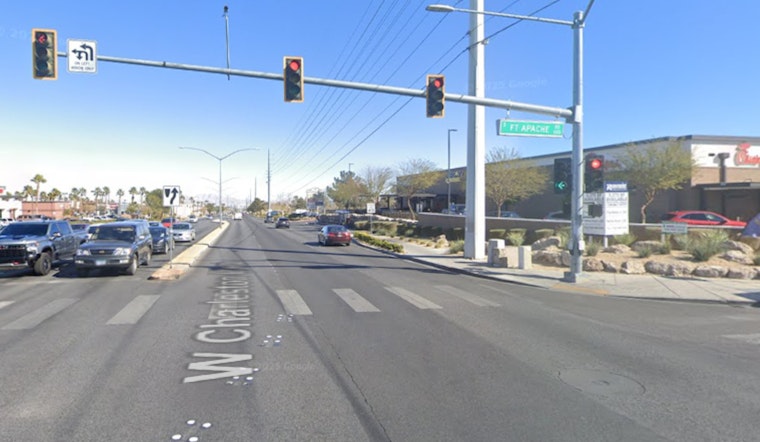
A quick-launch Las Vegas police drone helped find a missing child in a backyard near Charleston Boulevard and Fort Apache Road on Monday, reuniting the youngster with family just minutes after a frantic 911 call. When the child suddenly could not be found, the family dialed 911 and Metro’s Drone-as-a-First-Responder unit went into action to sweep the neighborhood. Police say the child was found safe and suffered no injuries.
The remotely piloted drone was equipped with a thermal-imaging camera that picked up a heat signature matching a small child behind a nearby home. From there, the DFR pilot guided officers and dispatchers straight to the spot, cutting what could have been a long ground search down to a matter of minutes. Department video shows the bright warmth on the thermal feed and an officer reaching the yard shortly after the signature appears on screen, according to FOX5.
How the Drone-as-a-First-Responder Works
Las Vegas Metro has been rolling out Project Blue Sky, a program that positions docked drones around the valley and flies them remotely from a centralized Fusion Watch center so aerial support can be in the air fast. The department says the drones stream live high-resolution and thermal video back to pilots and officers, giving responders eyes on the scene before they arrive. According to the Las Vegas Metropolitan Police Department, the setup is designed to boost officer safety and cut response times.
Officials told reporters the department flew roughly 10,000 drone missions in 2025 and now runs about 75 drones from multiple skyports, figures that helped justify the new operations center. The fleet includes docked Skydio X10 aircraft and other systems capable of beyond-line-of-sight flights and rapid launches. As reported by GovTech, Metro expects to increase monthly drone flights in 2026.
Metro officials emphasize that there are privacy rules baked into the program. Drone operators are instructed not to intentionally capture images of places where people would reasonably expect privacy, unless there is an emergency or a warrant authorizing it. Every flight is logged and audited. The department also holds FAA certificates of authorization that allow certain beyond-visual-line-of-sight missions for public safety. Leaders say those guardrails are part of their attempt to balance civil liberties with faster and safer responses.
The rapid find in this case highlights one of the department’s headline uses for drones: time-sensitive searches when minutes really matter. Local outlets have shared department video of the rescue; see 8 News Now for footage and additional details.




