

























































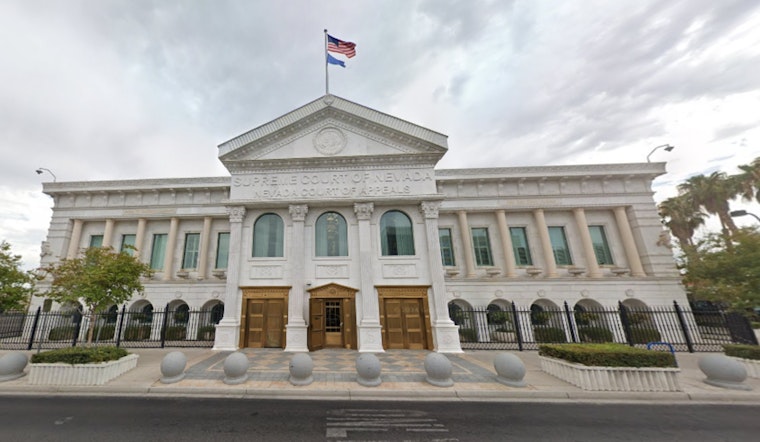
Deobra Redden, the Las Vegas defendant seen in a viral courtroom video vaulting over a judge’s bench, is now asking Nevada’s highest court for a legal do-over. He has petitioned the Nevada Supreme Court for a new trial, arguing that his trial lawyer’s work was so weak it violated his constitutional right to effective counsel. The move comes on the heels of Redden’s December sentencing to a decades-long term for the January 2024 attack.
Public defender says trial lawyer fell down on the job
In a brief filed with the Nevada Supreme Court on Dec. 22, public defender Kelsey Bernstein claimed that trial counsel Carl Arnold “failed to file any pretrial litigation” and “abandoned his client on appeal,” adding that Redden pleaded guilty “without any negotiations” and gained nothing in return for that plea. Bernstein argued that Arnold’s performance was “objectively unreasonable” and robbed Redden of genuine adversarial testing of the case.
Arnold has pushed back, saying he represented Redden’s family free of charge and that Redden chose to resolve the case after hearing testimony. The Nevada Supreme Court later removed Arnold from the appeal, referred him to the State Bar and ordered a $250 sanction while the disciplinary matter is reviewed, according to the Las Vegas Review-Journal.
From courtroom chaos to decades in prison
The now infamous incident unfolded on Jan. 3, 2024, at the Clark County Regional Justice Center. Redden suddenly leapt across the courtroom, charging District Judge Mary Kay Holthus and attacking her. The chaos injured Holthus, a courtroom marshal and a police officer, and the whole scene was captured on court video that quickly ricocheted around the internet.
Redden later pleaded guilty but mentally ill in September 2024 to attempted murder and related counts. In December, a judge sentenced him to 26 to 65 years in prison, with parole eligibility beginning after 2050, according to reporting by the Associated Press.
What it takes to prove a lawyer was ineffective
Winning an ineffective-assistance claim is no easy lift. An appellant has to show both that counsel’s work fell below an objective standard of reasonableness and that those failures actually harmed the defense, changing the result in a meaningful way. That two-part Strickland test, set by the U.S. Supreme Court, sets a high bar, and courts usually enforce it strictly.
For Redden, that means Bernstein must persuade the Nevada Supreme Court that Arnold’s alleged missteps likely altered the outcome, not just that the representation was less than ideal, as laid out by the Legal Information Institute.
What the Nevada Supreme Court can do next
Bernstein’s filing asks the state high court to either reverse Redden’s convictions outright or order a new trial. The court could request more briefing, sift through the trial record or deny the petition without a hearing. Any ruling could take months, and whatever the justices decide will determine whether Redden’s lengthy sentence stands or whether some parts of the case get a fresh airing in a new trial.
Courtroom safety and mental health back in the spotlight
The appeal has reopened simmering local questions about mental-health treatment in the criminal justice system, security measures in courtrooms and how judges handle defendants with serious psychiatric diagnoses. Judges, court staff and the victims from the January melee are likely to be watching closely as the Nevada Supreme Court weighs whether Redden’s leap from the gallery to the bench now turns into a second shot in court.




