

























































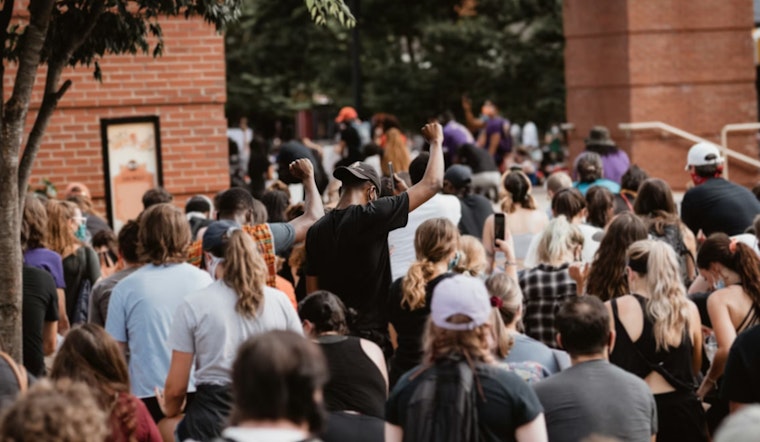
More than 50 San Antonio students left their campuses behind on Monday and headed straight for City Hall, then the Alamo, in a coordinated protest against cooperation between local officials, law enforcement and U.S. Immigration and Customs Enforcement. Gathering at the Municipal Plaza Building, the crowd held a press conference, chanted, waved handmade signs and ran a mutual-aid food drive all at once. Student leaders from dozens of campuses joined in, while volunteers collected nonperishable food for unhoused neighbors. As the march moved toward the Alamo, the group briefly clogged downtown sidewalks, turning a slice of the city center into a rolling civics lesson.
According to WOAI, the demonstration started at 2 p.m. outside the Municipal Plaza Building off West Commerce Street before making its way to the Alamo. The station reported that San Antonio Students For Peace coordinated the event with campus organizers, pairing the march with a press conference and mutual-aid drive. WOAI quoted high school organizer Daniel Perez saying students must not stay silent, and carried a statement from DakotaRei Frausto criticizing recent state actions as attempts to quiet student voices. The outlet framed the day as both a protest against ICE cooperation and an effort to support vulnerable residents.
The showdown between student activism and state oversight comes after the Texas Education Agency issued guidance warning that what it calls "inappropriate political activism" by students, teachers or school districts could trigger investigations, loss of state funding or even a state takeover of local school boards, according to the Texas Education Agency. The agency rolled out that guidance shortly after Commissioner Mike Morath named Levi Fuller on Feb. 4 as TEA's first Inspector General for Educator Misconduct, a position the agency says will oversee enforcement and investigations. Organizers and critics argue the new structure risks chilling student speech and educator support for civic engagement. TEA, for its part, has cast the moves as part of its obligation to keep students safe and protect instructional time.
Monday's action also built on a recent wave of student protests against ICE in the area. In late January, walkouts hit more than a dozen high schools across Bexar County as students rallied against federal immigration actions. The San Antonio Express-News reported that hundreds of students at multiple campuses joined those demonstrations, and that some districts warned that absences could lead to disciplinary measures even as they acknowledged a place for civic engagement. Organizers say those earlier walkouts helped galvanize student networks and put ICE cooperation under a brighter local spotlight ahead of Monday's downtown event. Parents and district officials have remained divided, with some applauding youth activism and others worrying about the hit to classroom time.
Organizers And Students Speak Out
Student leaders on Monday said their goals were twofold: protect immigrant neighbors and push city and county officials to end local cooperation with ICE. "Students are the future of this country, and staying silent means letting decisions be made without us," Daniel Perez told reporters. DakotaRei Frausto labeled recent TEA actions "a new era of McCarthyism" and accused state officials of using surveillance and enforcement to intimidate young activists, according to WOAI.
What The TEA Actions Could Mean
The TEA guidance gives districts and state officials a menu of enforcement options, from marking walkout participants absent to launching investigations that could affect a district's funding or even its local governance structure, as reported by The Texas Tribune. Critics, including teacher organizations and civil-liberties advocates, warn the policy could be used to target educators and cool off classroom discussions about current events. TEA officials insist the intent is to safeguard school operations and attendance. That tension is likely to shape how districts respond the next time students walk out. For many young people, the rules create an uneasy space between exercising civic voice and risking disciplinary blowback.
Mutual Aid And Next Steps
Alongside the chanting and speeches, organizers kept up a mutual-aid drive, asking students and supporters to bring nonperishable food items for unhoused community members. It is a tactic the group has used at other events, according to the organization's website. San Antonio Students For Peace describes itself as a youth-led nonprofit and includes contact information and social media links for volunteers and supporters. It is not yet clear whether any districts will launch formal investigations tied directly to Monday's downtown protest. Earlier responses to the January walkouts suggested a mix of enforcement and cautious support for student civic participation. Students told reporters they are prepared to organize additional actions if officials do not change local practices around ICE cooperation.
Monday's march shows how quickly student organizers can link neighborhood concerns to national fights over immigration and school governance, leaving city officials and school leaders trying to juggle public safety, attendance policies and political pressure. For now, students have turned downtown sidewalks into a stage for both protest and community care, even as state-level moves promise tighter scrutiny of campus activism. District statements and any follow up from TEA will help determine what that balance looks like in the days ahead.





