

























































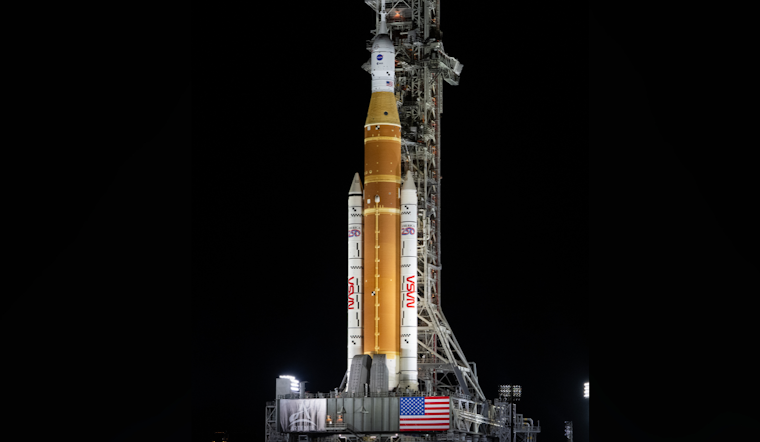
NASA's Artemis II moon rocket has passed a high-stakes fueling trial at Kennedy Space Center, loading more than 700,000 gallons of super-cold propellants during a two-day wet dress rehearsal that wrapped with a simulated launch countdown. The rehearsal, meant to flush out any last-minute issues before astronauts climb aboard, kept hydrogen concentrations within safety limits and included a pad closeout team practicing how to seal Orion's hatch. Teams briefly shifted to backup communications during tanking before restoring normal systems and pressing on.
What NASA said about the tanking
According to NASA, engineers executed two runs through terminal count, sent a pad closeout crew to demonstrate hatch closure, and then safely drained the rocket after loading liquid oxygen and liquid hydrogen. The agency reported that hydrogen gas concentrations stayed under allowable limits, which gave teams more confidence in seals that had been replaced on interfaces that leaked during an earlier rehearsal. NASA also said operators isolated the equipment that triggered the temporary loss of ground communications and continued fueling with backup methods while troubleshooting was underway.
What outside reporting adds
As reported by The Associated Press, the successful rehearsal boosts the chances that managers could set a launch date as soon as March 6, although officials emphasized that a firm date will wait for a full review of the data. The Associated Press noted that teams had previously replaced two seals and removed a clogged filter after an earlier tanking attempt was halted due to liquid hydrogen leaks. The outlet also reported that the four-member U.S.-Canadian crew is slated to begin roughly two weeks of quarantine late Friday to keep options open in the early March launch window.
Leak fixes and rehearsal hiccups
Before this latest run, an earlier wet dress rehearsal was stopped when engineers spotted a spike in liquid hydrogen leaking at a tail service mast umbilical, and teams then swapped out seals and examined ground-support hardware. Space.com reported that a February 12 partial "confidence" test showed restricted hydrogen flow that was traced to a faulty filter, which was replaced ahead of the full tanking. Managers also built extra hold time into the simulated countdown so controllers would have more room to troubleshoot during fueling operations.
NASA briefing and quarantine plans
In a media advisory, NASA said it will hold a briefing at 11 a.m. ET on Friday to walk through results from the test and outline next steps, with senior exploration officials scheduled to speak. The agency said the event will be streamed live and that the crew watched portions of the rehearsal from the Launch Control Center. NASA added that beginning the roughly 14-day quarantine for the crew in Houston helps preserve flexibility in the March launch window.
What comes next for Artemis II
Managers are set to comb through telemetry and hardware data before deciding whether to shift from rehearsal into full launch operations and carry out a formal flight-readiness review. The Associated Press reported that agency leaders are weighing whether design changes to the fuel-umbilical connections are needed to cut the risk of future leaks. If the data holds up, officials could clear a window for an early March launch and move into final launch processing.
How to watch and local note
NASA is keeping a 24/7 pad livestream online and providing separate camera feeds for the tanking activities, while local station WTSP carried live video of the agency update. Kennedy Space Center on Florida’s Space Coast remains the center of action as engineers dissect test results and prepare for follow-on reviews. NASA is expected to post more detailed analyses after the Friday briefing and throughout the upcoming flight-readiness process.
The exercise underscored how finicky cryogenic hydrogen fueling can be and how small hardware fixes can flip the script between delay and go. For now, managers have fresh data and a clearer path to decide whether Artemis II can hit an early March launch target.





_(cropped).jpg)