

























































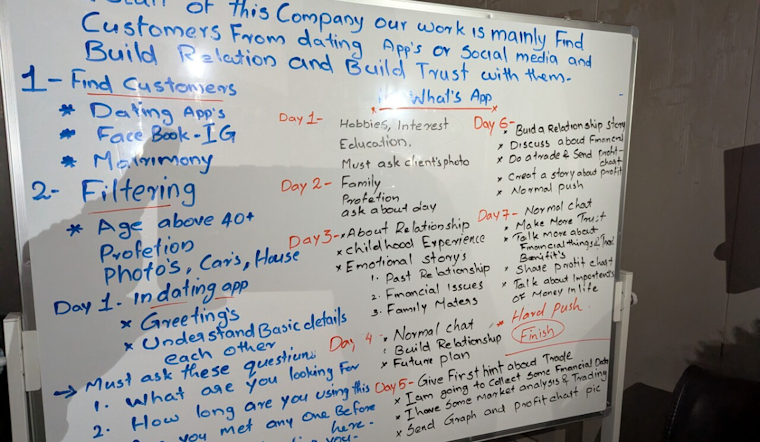
Federal agents in Baltimore are pulling back the curtain on how overseas scammers allegedly train staff to fleece Americans looking for love, after a handwritten “playbook” was recovered from a Cambodian scam compound.
The whiteboard-style notes, seized inside an office building raided by Cambodian police in January, laid out step-by-step instructions for choosing dating-app profiles, grooming targets and steering them onto bogus trading sites, FBI Supervisory Special Agent Keith Custer said, according to WMAR2 News. Staff were reportedly told to zero in on users age 40 and up and to scrutinize photos for signs of wealth, with the script even referring to people as “customers,” Custer said.
The discovery lands just as federal and state partners ramp up warnings ahead of Valentine’s Day about “relationship-investment” scams, where online romance turns into pressure to send money into fake crypto and trading platforms. Regulators say the playbook is one more sign of how tightly romance fraud and investment schemes have become intertwined.
This month, officials relaunched an interagency awareness push called “Dating or Defrauding?” to highlight practical red flags, according to the CFTC. The campaign, led by the Commodity Futures Trading Commission with more than a dozen federal and state partners, walks people through warning signs such as fake trading dashboards, suspicious payment requests and how to report suspected fraud.
Investigators say the scams often follow a familiar pattern: a friendly match on a dating app, a slow courtship, then a “hot tip” that moves the victim to a phony crypto or brokerage site that shows impressive but entirely fabricated gains. One Maryland man told authorities he watched a fake account appear to rack up about $150,000 in returns, only to be told he had to pay taxes and fees to withdraw and ultimately lost about $35,000. Agents say that slow grooming, isolation from friends and family and sudden urgent demands mirror what was laid out on the Cambodian whiteboard, according to WMAR2 News.
Crackdowns and the global picture
Law enforcement pressure on scam compounds across Southeast Asia has been building. In October 2025, the U.S. Treasury and international partners sanctioned an alleged transnational network and unsealed related criminal cases, tying multimillion-dollar money flows and forced-labor allegations to organized fraud hubs, according to the U.S. Treasury. Officials said the network relied on corporate fronts and crypto infrastructure to wash illicit proceeds and keep the compounds running.
Forced labor, scripts and AI
Human-rights reporting has found that many of these compounds operate like coercive work camps, where trafficked workers are forced to run online scams under threat of violence and financial penalties. Amnesty International has documented more than 50 suspected sites and dozens of survivor accounts describing confinement, beatings and constant surveillance, according to Amnesty International.
Recent investigative reporting has also surfaced leaked internal chats and detailed scripts that map out the daily mechanics of scamming. Those leaks show how managers use tight monitoring, canned emotional pitches and generative tools to scale deception and keep workers on script, according to WIRED.
Legal fallout
Globally, governments are responding with sanctions, asset freezes and criminal indictments. In early January, Cambodia extradited an alleged ringleader to China as part of a broader wave of cooperation, and U.S. prosecutors have unsealed cases targeting the networks behind the compounds. The aim is to follow crypto trails, seize illicit assets and reach the people accused of organizing or profiting from the fraud, according to the AP.
How to protect yourself
The FBI’s advice is not glamorous, but it is blunt and practical: do not send money to someone you have never met in person. Agents say you should keep conversations on the dating platform until you have independently verified who you are talking to, and be extremely wary of anyone pushing you to act quickly, switch to encrypted apps or use unusual payment methods.
If you suspect you have been targeted, the FBI recommends saving all messages, blocking the scammer and reporting the incident immediately to the Internet Crime Complaint Center (IC3) and to your bank or other financial institution, according to the FBI.




