

























































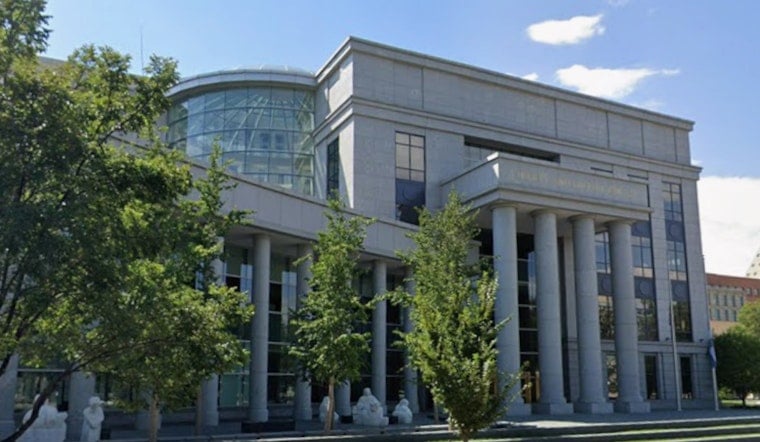
The Colorado Supreme Court on Monday left intact a lower court’s ruling that rejected a Black defendant’s argument that Arapahoe County prosecutors singled him out for adult prosecution in a murder case. The case dates back to May 2019, when 18-year-old Lloyd Chavez IV was fatally shot during an attempted robbery over vaping products outside his Centennial home. Two co-defendants later cooperated with prosecutors and went through juvenile court, while Demarea Mitchell and Kenneth Alfonso Gallegos were tried as adults and are serving life sentences. With this decision, both the convictions and the legal standard Colorado courts will use in selective-prosecution claims stay in place.
What the court said
In a Feb. 2 opinion, the Colorado Supreme Court affirmed the Court of Appeals and the trial court, concluding that Mitchell failed to make the required showing of selective prosecution. Justice Richard L. Gabriel wrote that Mitchell was not similarly situated to his non-Black codefendants because the record supported a finding that he “escalated the situation” by confronting Chavez and then firing the shot. The justices also found that the broad statistical evidence offered by the defense was too generalized, without case-level comparisons, to prove either a discriminatory effect or a discriminatory purpose.
Case background
The dispute grew out of a May 2019 meetup arranged to buy vape supplies in Centennial that ended in the shooting death of Chavez outside his home. Police and witnesses gave differing accounts after the incident, but J.S. and D.S. later cooperated with investigators and pleaded guilty in juvenile court, receiving two-year placements, while Mitchell and Gallegos were prosecuted as adults. Those details, along with the underlying court record, were reported by the Denver Gazette.
Defense's argument
Mitchell’s attorney told the justices that prosecutors extended plea bargains to the two non-Black codefendants, who then implicated Mitchell, and that Arapahoe County data showed Black juveniles were more likely to be prosecuted as adults and to receive prison sentences. Defense lawyer Patrick R. Henson contended that the combination of targeted plea offers and those statistics showed a discriminatory effect. Prosecutors responded that the two co-defendants offered proffers and cooperation that, in their view, justified different treatment during plea negotiations, as reported at oral argument by Colorado Politics.
Legal implications
The opinion reiterates the familiar two-part test for selective prosecution: a defendant must show both a discriminatory effect and a discriminatory purpose, and the fact that codefendants share an initial charge does not automatically make them similarly situated. The court stressed that statistical evidence must be paired with case-level comparators demonstrating that non-Black defendants faced the same factual circumstances to establish a claim. That standard leaves prosecutors with broad discretion over charging and plea decisions unless a defendant can point to specific, comparable cases. Colorado Supreme Court.
What's next
The ruling keeps Mitchell’s conviction and life sentence in place and shuts down this particular route for relief, at least for now, although defense lawyers have signaled they may pursue other avenues of review or seek discovery into charging practices. The decision will likely make it more difficult for selective-prosecution challenges based on county-level statistics alone to succeed in Colorado courts without tightly matched comparator cases. For more reporting and the court’s full opinion, see the Denver Gazette.





