

























































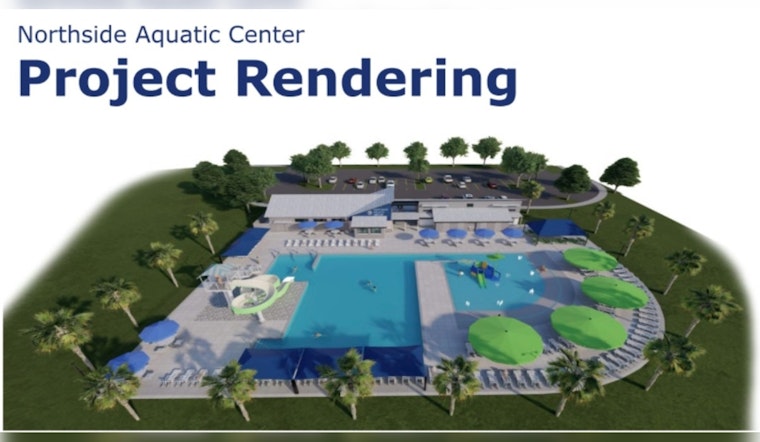
Corpus Christi is on track to sign off on an $8.7 million Northside Aquatic Center even as the city remains stuck in Stage 3 drought restrictions and the western reservoirs that supply much of the Coastal Bend sit at historic lows. The pool is not a brand-new idea but part of a decade-old mitigation package tied to the new Harbor Bridge, born out of a 2015 Title VI civil-rights agreement. That legal obligation now collides with warnings from water managers that the region could hit a Level 1 water emergency within about a year if new water supplies are not brought online.
In a statement, the City of Corpus Christi stressed that the Northside Aquatic Center is not a new discretionary project but a required mitigation commitment under the 2015 Title VI agreement, and said approving a construction contract keeps the city in line with federal sequencing requirements. The city added that it will continue water-conservation measures while simultaneously carrying out federally mandated commitments.
What the plan includes
The Northside Aquatic Center design calls for roughly a 13,500-square-foot pool with a six-lane, 25-yard competition area, a zero-entry beach, and a children's play unit, along with a bathhouse, shade structures, and a 92-space parking lot, according to KRIS 6 News and project documents. The state project registry lists the site at 1921 Winnebago Street near Lake Street, and notes that the council was set to consider awarding an $8,709,077.22 construction contract to South Texas Building Partners to build the facility, according to the registry at TDLR TABS.
The investment stems from a voluntary resolution reached after a Title VI complaint filed in 2015 alleged the proposed Harbor Bridge route would disproportionately burden the Hillcrest and Washington-Coles neighborhoods. The Lawyers’ Committee for Civil Rights Under Law says the resulting agreements required mitigation measures, including park upgrades, relocation assistance, and new recreational facilities, to address historic harms in those communities.
The timing is drawing scrutiny because city water-supply modeling shows the western reservoirs that feed much of the Coastal Bend at record lows, and warns that without additional supply projects the region could trigger a Level 1 water emergency as early as November 2026. Those projections appear on the City of Corpus Christi water dashboard, which also notes that Stage 3 restrictions remain in effect.
Supporters of the project argue that it replaces amenities lost when T.C. Ayers Park and other public spaces were taken out to make way for the Harbor Bridge project, and they point to nearly $16.5 million the city approved last year to launch related park and trail mitigation. Reporting by MySA details the legal obligation and the local back-and-forth over whether to proceed while severe drought conditions continue.
Legal implications
Because the mitigation was negotiated under federal oversight, the Four-Party Agreement includes enforceable mitigation and relocation measures and gives federal agencies oversight roles, the Lawyers’ Committee noted in its 2015 release. That structure means that significant changes to the mitigation plan would likely need review by the Federal Highway Administration, leaving the city with limited room to delay or cancel promised elements without federal approval.
If the council signs off on the construction contract, city officials say work would begin after the award, and local reporting indicates the project schedule and bond funding are already lined up. How council action and the next round of water-supply updates intersect will determine how leaders balance compliance with the settlement against the city’s drought response, local officials told KRIS 6 News.





