

























































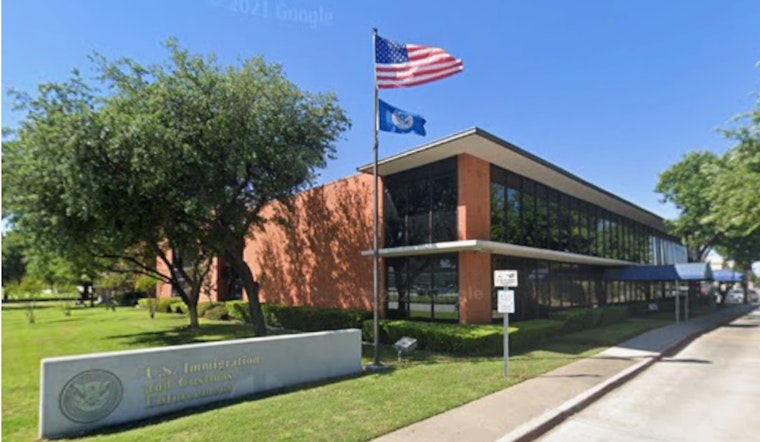
Hours of unanswered calls, conflicting information and growing panic. That is how relatives and attorneys describe their Saturday, after learning that 33-year-old Palestinian detainee Leqaa Kordia had been rushed from the Prairieland Detention Center in Alvarado to a hospital following a medical episode. Family members say she fell, hit her head and suffered a seizure. What they did not have, for a long stretch of the day, was a clear answer on where she was or what shape she was in.
The confusion has put fresh heat on the North Texas immigration lockup and on federal officials, with critics accusing the government of keeping families and lawyers in the dark at the very moment they most need information.
According to The Dallas Morning News, written correspondence from Immigration and Customs Enforcement informed Kordia’s attorneys that she remained hospitalized. By the time they got that confirmation, lawyers say they had already called 16 different hospitals across the Dallas–Fort Worth area trying to track her down. State Rep. Salman Bhojani publicly described the detention center as “a black box,” while State Rep. Gene Wu said the federal government’s handling of cases like Kordia’s is “intentionally being cruel.” Relatives say they have watched her health decline while she has been held at Prairieland, and attorneys argue the long silence around her hospitalization has only amplified the family’s fear.
Lawyers Push For Release While Searching For Answers
Kordia’s legal team, which includes the Texas Civil Rights Project, the Boston University Immigrants’ Rights Clinic and Muslim Advocates, has been fighting in federal court to get her out. They say a tangle of administrative stays has kept her behind bars even after judges said she should be released.
Golnaz Fakhimi of Muslim Advocates called the latest episode one facet of the cruelty of an immigration detention system defined by cruelty. Attorneys have asked a federal judge for emergency relief and argue that the medical scare drives home their point that Kordia should not remain detained while her case winds through the courts.
How She Ended Up At Prairieland
Kordia was first detained in March 2025 after what her legal team describes as a voluntary check-in with ICE in Newark. She was then flown to the Prairieland facility, located about 35 miles southwest of downtown Dallas, according to The Dallas Morning News. The Department of Homeland Security has said her case arises from an expired F‑1 student visa. Kordia and her attorneys counter that she was singled out for her role in pro‑Palestinian protests and note that criminal charges tied to a 2024 Columbia University demonstration were later dropped.
Her relatives say she has no family living near the North Texas facility, and that the distance, combined with limited visitation, has made it much harder for them to monitor her health and conditions inside.
Court Battle And Administrative Stays
Federal filings and public statements from Kordia’s counsel describe a legal tug‑of‑war that has kept her in custody. Last June, Magistrate Judge Rebecca Rutherford recommended that she be released. Immigration judges have twice set bond at amounts her supporters say could be paid. Each time, according to Muslim Advocates, the Department of Homeland Security invoked automatic stays that halted any transfer out of detention.
Lawyers argue that those stays effectively strip detainees of basic procedural protections and have urged a federal court to step in with relief while broader legal challenges to the practice move forward.
Broader Questions About Care In Detention
Advocates say what is happening to Kordia fits into a larger and more troubling pattern around health care in immigration custody. A U.S. Senate investigation, along with reporting by the Associated Press, has documented dozens of credible complaints of delayed or inadequate medical care at detention centers across the country.
ICE’s own facility information page lists Prairieland’s address and a 24‑hour phone line for family members or attorneys who need to ask about a detained person. In practice, lawyers say those numbers, along with in‑person visits, do not always yield quick answers when someone has been taken to a hospital. The agency lists the North Texas complex on its site as ICE’s Prairieland Detention Center.
What Comes Next
Kordia’s attorneys say they plan to keep pressing the federal court for immediate relief while her relatives and Texas lawmakers demand more transparency from the Department of Homeland Security and ICE. State legislators and advocates have sent letters to federal officials and held press events in North Texas calling for her release, as reported by KERA.
For now, the family says it is concentrating on getting straight answers about Kordia’s condition in the hospital and on securing her release if doctors say she is stable enough to travel.





