

























































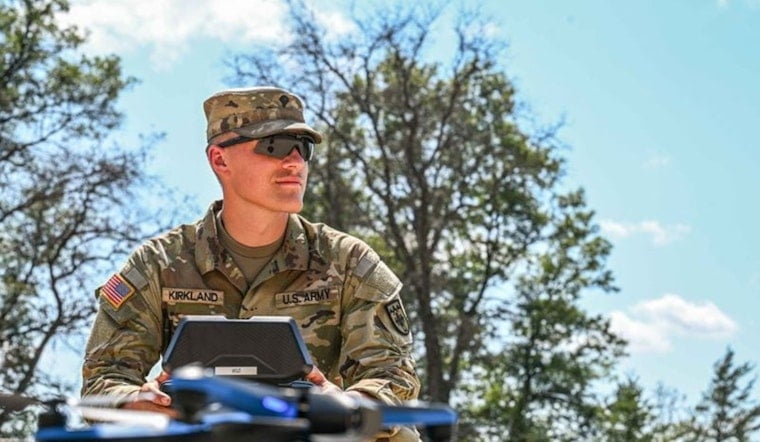
Northern Michigan is officially on the drone map. The National All‑Domain Warfighting Center in the upper part of the state has been tapped as a national drone test range, a move state leaders say could pull more aerospace work of all kinds into Michigan, from early research and flight trials to eventual manufacturing. The designation pulls Camp Grayling and the Alpena Combat Readiness Training Center into what officials are pitching as a single, year‑round proving ground for uncrewed aerial systems, capping years of state spending on flight corridors, university labs and even urban rooftop test pads where companies can shake out new hardware and software.
The Department of War’s decision to name the National All‑Domain Warfighting Center a national range for “deep uncrewed aerial systems” training was announced on Feb. 6 by the Michigan Department of Military and Veterans Affairs, according to the Michigan Department of Military and Veterans Affairs. Gov. Gretchen Whitmer said the designation should make Michigan more attractive to cutting‑edge defense and aerospace companies and help create high‑skill jobs, the release said.
Anchored by nearly 200,000 acres at Camp Grayling and more than 17,000 square miles of special‑use military airspace at Alpena, the center offers scale and a four‑season testing environment that the U.S. Army says is hard to find east of the Mississippi. The Army and National Guard Bureau, which helped select the site, highlighted the range’s ability to run live‑fire, counter‑UAS and swarm operations at operational tempo, according to the U.S. Army.
Congress and the Pentagon Back the Move
Michigan’s congressional delegation pushed hard for the designation, and lawmakers from both parties are calling it a strategic win for the state’s defense industrial base. In a joint announcement, Sen. Elissa Slotkin and other Michigan members of Congress said the center’s mix of expansive airspace, established training ranges and nearby suppliers makes it an ideal place to scale up military drone testing, according to Sen. Elissa Slotkin.
Testing Infrastructure Already In Place
Michigan has quietly been building an ecosystem around drones and electric aircraft. A roughly 40‑mile M‑Air research corridor now links Ann Arbor to Detroit, with ground‑based “iron bird” testbeds that let engineers run motors and batteries through their paces before anything leaves the ground. The University of Michigan’s M‑Air effort and the Michigan Unmanned Aerial Systems Consortium give researchers and companies places to test beyond‑visual‑line‑of‑sight operations, according to the Michigan Unmanned Aerial Systems Consortium.
Urban Labs and Rooftop Flight Tests
Far from the northern training ranges, Detroit offers a very different kind of proving ground: controlled urban testing. A rooftop flight space at the Detroit Smart Parking Lab has state and federal backing to help companies trial package delivery and logistics systems in a city setting. The DSPL project, funded in part through an EDA grant and run by NextEnergy and Bedrock, is meant to shorten the path from prototype to real‑world street trials, according to Michigan Economic Development Corporation.
Why This Could Mean Manufacturing Jobs
State leaders are pitching the designation as a way to bolt Michigan’s deep automotive supply chain onto new aerospace work. The argument is that the same stamping plants and electronics suppliers that feed car lines today could retool for drone and eVTOL components tomorrow. Lawmakers in Washington are already steering funding toward the National All‑Domain Warfighting Center and related exercises, a move supporters say will help draw prime contractors and suppliers to the state, according to Sen. Gary Peters’ Office.
What Comes Next
The Michigan Economic Development Corporation this month released a five‑year Defense and Aerospace Strategic Plan that maps out how testing corridors, university research programs and military ranges might be turned into long‑term industrial investment and workforce training hubs, the agency wrote. The plan calls for coordinated action among universities, industry and defense assets to grow dual‑use technologies and the companies that manufacture them in Michigan, according to Michigan Economic Development Corporation.
The Detroit Free Press first laid out many of these details and cast the move as part of a broader push to “make it” in Michigan’s skies, as local outlets have noted. The next test will be whether that national‑range label and the flurry of planning documents translate into steady local work, federal contracts and a busier test calendar in the months ahead.



