

























































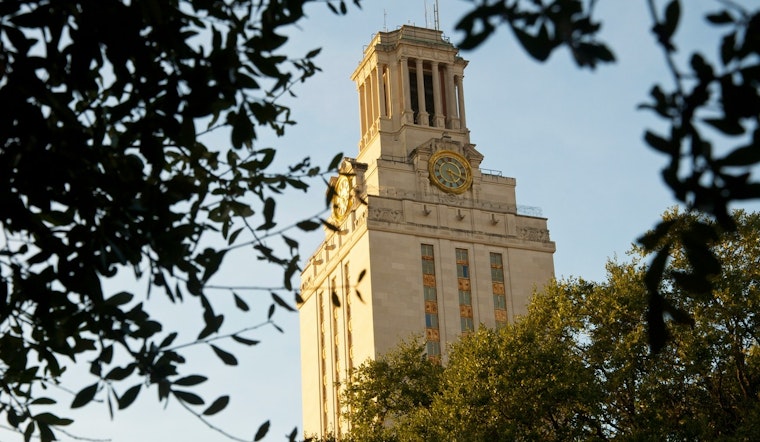
A former University of Texas professor quietly tried to pull Jeffrey Epstein’s money into a high-minded campus event on sexual consent, according to newly released federal records that have revived an uncomfortable chapter in UT’s recent history.
In August 2015, on UT Classics department letterhead, longtime classics professor Thomas Hubbard wrote to the Jeffrey Epstein VI Foundation asking for roughly $10,000 to $20,000 to help fund a 2016 conference called “Theorizing Consent.” The conference, he wrote, would “interrogate” what sexual consent means on college campuses. The ask was meant to supplement an existing $12,000 budget and to “contribute toward the goal of giving this conference greater visibility,” according to documents first reported by the Austin American-Statesman. Hubbard described a cross-disciplinary series of panels that would question federal Title IX guidance and the university’s role in policing student sexual conduct, and told reporters he believed Epstein’s 2008 conviction might actually make the foundation receptive. Hubbard says the foundation ultimately did not donate.
Inside the Conference and the Scramble for Cash
The University of Texas listed Theorizing Consent as a two-day event that ran April 29–30, 2016, with sessions staged in the Flawn Academic Center and co-sponsorship from several groups, including the William A. Percy Foundation. Program materials show panels on Title IX, Clery Act reporting, and “the concept of sexual consent,” and records indicate the starting budget was modest enough that Hubbard went hunting for outside money to expand the speaker lineup. Reporting later noted that Hubbard turned to a centennial professorship endowment to help cover expenses, according to The Daily Texan.
Protests, Lawsuits and a Pricey Exit From UT
By the time the conference materialized, Hubbard was already a lightning rod on campus. His scholarship and courses, including offerings titled “Mythology of Rape” and “Child and Adolescent Sexuality,” sparked student protests and accusations that he promoted pederasty, allegations he has denied. Hubbard responded in part by filing libel suits against several student activists, and those courtroom fights caught the eye of state lawmakers who were weighing changes to tenure protections.
Hubbard ultimately left UT in 2021 after what reporting described as a roughly $700,000 settlement tied to his immediate retirement, as detailed by the Houston Chronicle.
Epstein Files Put Old Fundraising Pitch Back in the Spotlight
The fundraising letter resurfaced in a mass disclosure of Jeffrey Epstein-related materials that the U.S. Department of Justice began rolling out in late 2025 and January 2026. The agency says the release is part of its obligations under the Epstein Files Transparency Act and has created a searchable online library of responsive records, according to the Department of Justice.
The trove has renewed scrutiny of how Epstein courted universities and research institutions. His foundation steered millions of dollars toward elite schools, and reporting by Politico detailed how Harvard later pledged to redirect unspent Epstein gifts. At the same time, legal experts and news outlets have warned that appearing in the files does not, by itself, prove wrongdoing and that redactions and context are crucial when reading the documents, cautioned The Guardian.
In a statement responding to questions about the letter, Hubbard defended his outreach to Epstein’s foundation. He said he believed Epstein “might have been interested in furthering critical discussion of the contours of consent,” and added that he was “not then and am not now aware of any evidence that Jeffrey Epstein was a ‘pedophile’ in the technical sense.” The Houston Chronicle reported those remarks and noted that university officials did not respond to requests for comment.
Legal Stakes for the Former Professor
The newly released public records do not accuse Hubbard of any crime. There are no criminal allegations against him tied to the fundraising letters, which sit in a broader investigative archive rather than an indictment. His civil disputes with student critics, including the defamation suits and the settlement that preceded his departure from UT, remain part of the public record and were covered in local reporting, according to The Texas Tribune.


