

























































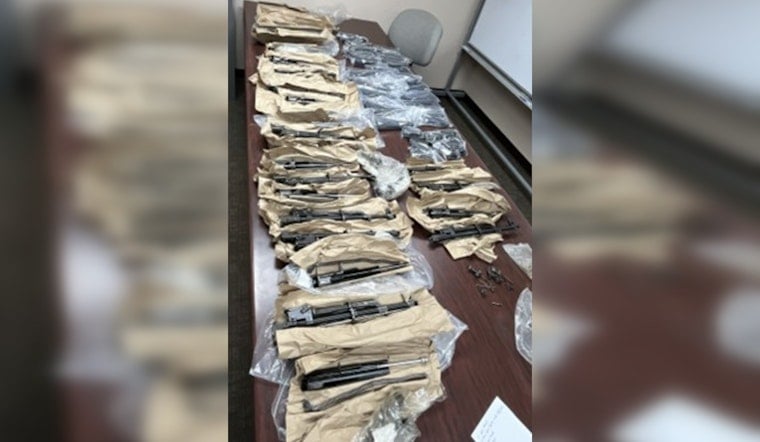
A McAllen man is headed to federal prison after authorities say they helped rip out a key piece of a weapons-trafficking pipeline running through the Rio Grande Valley and into Mexico.
On Tuesday, a federal judge sentenced Mario Cardenas Jr. to more than five years behind bars, followed by three years of supervised release, for illegally exporting firearm parts into Mexico. Investigators say the case was a central piece of a broader push to shut down a major trafficking ring based in the Valley.
HSI McAllen dismantled a major firearms trafficking ring: On Feb 10, Mario Cardenas, Jr. was sentenced to more than 5 yrs in prison & 3 years supervised release for illegally exporting firearms parts into Mexico. #BorderSecurity pic.twitter.com/eZMW0CC2r2
— HSI San Antonio (@HSI_SanAntonio) February 12, 2026
HSI Outlines McAllen Gun Parts Scheme
Homeland Security Investigations (HSI) San Antonio went public with the outcome on X, crediting its McAllen office with having “dismantled a major firearms trafficking ring” and noting that Cardenas Jr. was sentenced on Feb. 10. According to HSI San Antonio, the conviction is tied to the illegal export of firearm components that were headed to Mexico.
Why Traffickers Love Parts Instead of Full Guns
Federal agents say traffickers are increasingly steering away from fully assembled weapons and instead pushing boxes of parts that can be turned into complete firearms on the other side of the border. That shift makes it tougher to trace guns and complicates front-line enforcement.
The National Firearms Commerce and Trafficking Assessment from the Bureau of Alcohol, Tobacco, Firearms and Explosives (ATF) found more trace requests linked to guns recovered in Mexico and identified Texas as a leading source state for firearms traced across the border. ATF's analysis maps that trend and the enforcement headache that comes with it.
McAllen Cases Reflect a Wider Border Crackdown
Prosecutors in the Southern District of Texas have been stacking up similar export cases out of the Valley. In March 2025, a McAllen court sentenced Oscar Daniel Ramirez Gonzalez to two years in prison after agents at the Pharr port of entry found receivers, gunpowder and thousands of rounds, according to the U.S. Attorney’s Office.
That prosecution, handled with Customs and Border Protection involvement, is the kind of seizure federal authorities point to when they argue that stepped-up inspections and joint operations are putting a dent in the flow of weapon parts leaving South Texas. U.S. Attorney’s Office, Southern District of Texas published the sentencing details.
The Law Behind Exporting Gun Parts
Cases like Cardenas Jr.’s are typically brought under federal smuggling and export-control laws. One of the main tools is 18 U.S.C. § 554, which makes it a crime to export or attempt to export goods “contrary to any law or regulation of the United States” and carries a potential sentence of up to 10 years in prison.
Prosecutors and courts also lean on export-control regulations overseen by the State and Commerce Departments when firearm components qualify as defense articles or require licenses before they can leave the country. The statute itself is available at 18 U.S.C. § 554.
HSI officials say Cardenas Jr.’s sentence is part of ongoing efforts to disrupt weapons procurement networks along the border and to reduce the flow of firepower into Mexico. Federal prosecutors and local partners in the Rio Grande Valley are continuing to follow additional leads tied to the same trafficking corridors, officials added.





