

























































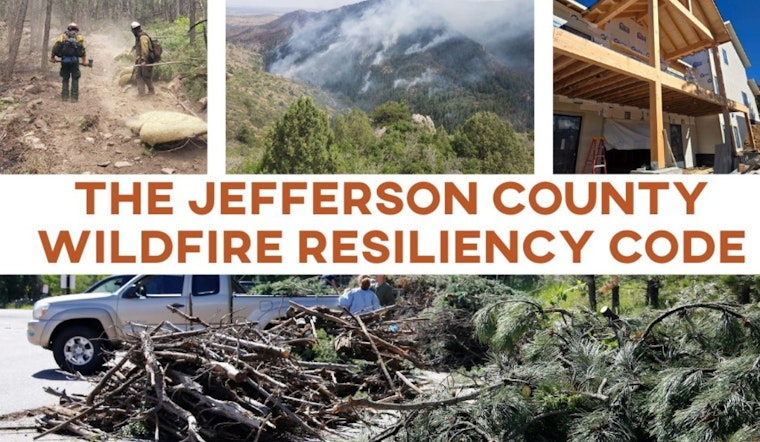
Wildfire rules could soon get a lot tougher in unincorporated Jefferson County, with the Planning Commission set to take its first formal look at a draft Wildfire Resiliency Code next Wednesday. The proposal would expand the county’s wildland‑urban interface and tighten defensible‑space and home‑hardening requirements across unincorporated Jeffco. If the commission signs off and forwards the draft, the Board of County Commissioners is slated to vote on March 10, potentially changing when and how homeowners must upgrade roofs, siding, and landscaping. County officials say the goal is to align local rules with newer state standards and cut the odds of another fast‑moving blaze.
According to Jefferson County, the Planning Commission hearing is scheduled for next Wednesday at 6:15 p.m., and the Board of County Commissioners is scheduled to consider adoption on March 10. The county lists the draft under case number 25‑127495AM and notes that hearings are hybrid, with the in‑person session in Hearing Room 1 at 100 Jefferson County Parkway in Golden. The same page explains how to submit written comments and lists county contacts for questions about the case.
The draft is Jefferson County’s local spin on the statewide 2025 Colorado Wildfire Resiliency Code, which the Wildfire Resiliency Code Board adopted on July 1, 2025, and which sets minimum standards for structure hardening, defensible space, and WUI mapping, according to the state’s board materials. The state gave local governments a timetable to adopt rules that meet or exceed the model and be compliant by July 1, a schedule that tightens the window for county review and public input. State guidance lays out the three‑zone defensible‑space approach and two structure‑hardening classes that local governments are now translating into their own permitting rules.
What the draft would require
As outlined by Jefferson County, the proposed Wildfire Resiliency Code would push the county’s WUI map farther into the plains and update defensible‑space and structure‑hardening standards across unincorporated Jeffco. The draft focuses on new construction and exterior alterations, specifically flagging projects such as re‑roofing, re‑siding, deck replacements and additions, and it would prohibit combustible mulch or plantings within five feet of structures. The county’s summary also calls for Class A roofing, ignition‑resistant siding and decking choices, performance standards for ventilation openings to keep out embers, and limits on highly flammable plants within 30 feet of homes.
Who will be affected
The rules would apply only within the county’s WUI overlay in unincorporated areas, but mapping changes could pull more properties into the zone, particularly along the foothills‑to‑plains transition, municipal explainers show. Local reports note that the code typically kicks in for new homes, additions above certain thresholds and major roof work, such as replacing a substantial share of a roof’s surface. That means some otherwise routine renovation projects could now require tougher materials or extra permits. Homeowners eyeing roofing, siding or deck jobs are being urged to look at the proposed WUI map and the draft standards before locking in contractors.
Enforcement and cost questions
Officials in several Colorado counties have cautioned that adopting the state model could drive up permitting workloads and enforcement costs because of additional inspections and permit reviews. Reporting by the Durango Herald details concerns that more stringent hardening rules may raise construction costs and strain small county staffs tasked with implementation. Jefferson County leaders say the standards aim to improve safety and, over time, help steady homeowner insurance in high‑risk areas, but neighbors and builders are expected to come with pointed questions when the hearings open.
Legal and regulatory backdrop
The requirement for a statewide process comes from Senate Bill 23‑166, which created the Wildfire Resiliency Code Board and directed it to adopt model codes and a state WUI map, according to the Colorado General Assembly. The law tells governing bodies that oversee building and fire codes to adopt standards that meet or exceed the state minimums on a set timetable, and it sets up a path for local governments to petition the state board for map or code changes. That framework is what has Jefferson County running the draft through referrals, a Planning Commission hearing and then a final decision by the commissioners.
How to attend and comment
The county has posted hearing details and a link to join the virtual meeting on its Facebook page, which also directs residents to the county’s case folder for draft documents and related materials. For the Facebook notice, see the Jefferson County post on Facebook. Questions about the process or how to submit a written comment are listed on the county’s regulation page and in the case folder, and public testimony at hearings is limited to short time slots so more people can weigh in.





