

























































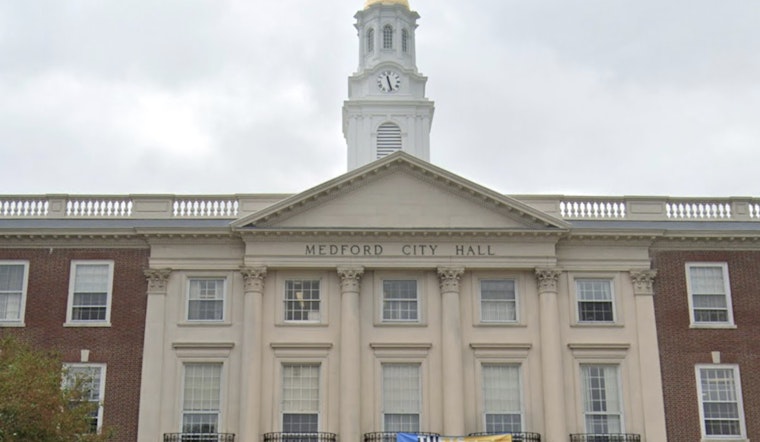
Medford’s latest political fight has jumped from City Hall chambers to a federal courtroom, with two residents asking a judge to put the brakes on the city’s new Values-Aligned Local Investments Ordinance. They argue the measure forces local officials to choose between screening investments on political or ethical grounds and their legal duty to safeguard taxpayer money, turning a tense council debate into an early federal test of how far cities can go in using public investments to push human-rights and climate goals.
Federal lawsuit lands in court
The lawsuit was filed on Feb. 5, 2026, in U.S. District Court for the District of Massachusetts, according to the docket on Justia Dockets & Filings. Medford residents Zachary R. Chertok and Eliot Jokelson are listed as plaintiffs, while the City of Medford, the Medford City Council and Mayor Breanna Lungo-Koehn are named as defendants. The complaint seeks a declaratory judgment that the ordinance is unlawful and asks the court for an injunction stopping the city from carrying it out, as reported by The Tufts Daily.
What the ordinance would ban
The ordinance instructs the city’s Treasurer-Collector to pull public funds from companies that earn more than 15% of their revenue from fossil fuels, from private prisons, from weapons manufacturers and from entities “directly, knowingly and over time contributing to severe violations of human rights.” To decide which companies fall into those categories, it relies on the MSCI ESG Controversies and Global Norms Methodology. The measure sets a Dec. 31, 2025 deadline for divesting currently invested funds and includes a narrow exception for the retirement system, according to the ordinance text posted by the City of Medford.
Plaintiffs and backers say law crosses the line
The complaint contends that the ordinance is preempted by federal law and clashes with Massachusetts statutes that require municipal investments to prioritize safety, liquidity and yield. It cites the Supreme Court’s Crosby v. National Foreign Trade Council decision in arguing that Medford is stepping into territory reserved for higher levels of government. The case is backed by the Gevura Fund and the National Jewish Advocacy Center, which argue that the ordinance’s broad language could amount to an ideological boycott. Litigation counsel Rachel Sebbag wrote that the law is “preempted by both federal and state law,” according to The Tufts Daily. Mark Goldfeder of the National Jewish Advocacy Center told JNS that the case is intended to stop what he described as a municipal ideological boycott.
Council leaders defend the policy
Council leaders who championed the ordinance say it is about aligning public dollars with community values, not about staging boycotts. Council President Isaac Bears, who sponsored the measure, has said the law is about “responsible stewardship” of taxpayer funds and that it leans on widely used ethical screening standards, according to reporting by Boston.com. Bears has argued that similar approaches have been adopted in other U.S. municipalities and that Medford should act as a “responsible steward” of public money.
What’s next
The plaintiffs are asking the court to halt enforcement of the ordinance while the case moves forward, a decision that will be up to the federal judge assigned to the matter. On the docket, the lawsuit appears as Chertok et al v. City of Medford, No. 1:2026cv10589, according to Justia Dockets & Filings. A ruling in favor of the residents could curb efforts by other municipalities that are weighing similar values-based investment policies.
Mayor, residents remain divided
Mayor Breanna Lungo-Koehn vetoed the ordinance in October, warning of potential legal and financial fallout, but the City Council overrode her veto in November. Her veto letter, along with the ordinance text, is posted on the City of Medford website. At the time of reporting, Medford officials had not issued a full response to the lawsuit, according to Boston.com. The fight has left residents and local organizations deeply split over whether the city’s investment strategy should reflect ethical priorities or stick strictly to traditional fiduciary standards.


