

























































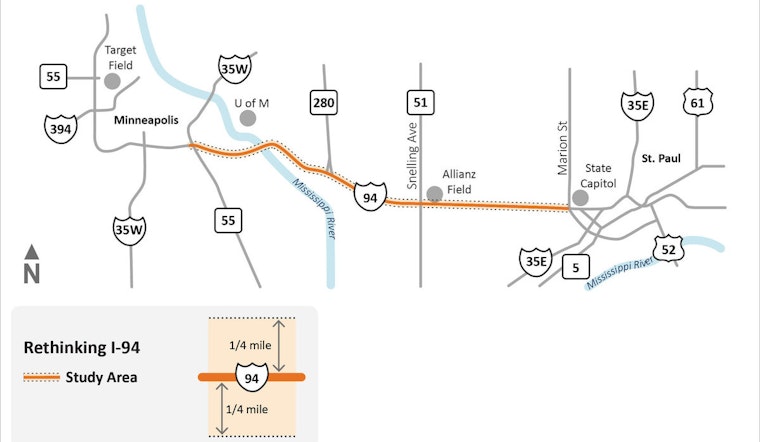
If you have thoughts about the future of Interstate 94 between Minneapolis and St. Paul, you just picked up two extra weeks to weigh in.
MnDOT has pushed back the public comment deadline for its Rethinking I-94 scoping documents to March 23, adding 14 days to the original schedule. The extension covers both the Scoping Document/Draft Scoping Decision Document and the state Environmental Assessment Worksheet for the 7.5-mile segment of I-94 between Minnesota 55/Hiawatha Avenue in Minneapolis and Marion Street in St. Paul, giving residents more time to speak up about how the corridor should be rebuilt.
According to MnDOT, the official comment period opened January 6 and was initially set for 60 days. The agency says the two-week extension is meant to give the public more time to review the hefty documents. The Rethinking I-94 web page notes that Environmental Quality Board monitor and newspaper notices are set to publish March 3 with the revised deadline. MnDOT is also offering hard-copy documents at select locations and an online comment form for people who prefer paper or in-person options.
What is on the table
MnDOT has narrowed the alternatives recommended to move ahead to the No-Build option plus a package of rebuild-and-maintain concepts: Maintenance B (which would provide consistent bus shoulders), Reduced Freeway and Reconfigured Freeway. As reported by the Pioneer Press, the choices range from keeping the interstate largely as it is to rebuilding lanes so that some would operate as managed lanes for buses, carpools and toll-paying drivers during peak hours, or trimming the number of general-purpose lanes in certain stretches.
MnDOT's materials describe versions that would retain a freeway while giving transit more reliable access, including concepts where managed lanes come into play. Under the Maintenance B alternative, the focus is on extending consistent bus shoulders throughout the corridor rather than redefining the freeway itself.
Where the debate is
Transit and neighborhood advocates have been pushing for an at-grade "Twin Cities Boulevard" concept that would fill in the highway trench and reconnect Rondo and other neighborhoods that were split when I-94 went in. That idea, however, did not make MnDOT's short list of recommended alternatives, and that omission has become a flash point for community groups.
Advocacy organizations such as Our Streets are urging residents to use the extended comment period to call for more transformative, community-focused options to be put back on the table. Local leaders and some residents argue that the current scoping decision leans too heavily on engineering and cost tradeoffs and not enough on reparative strategies for neighborhoods that have long lived with the impacts of the freeway.
How to weigh in and what comes next
MnDOT says all public comments will become part of the official record and will help shape the Tier 1 environmental review, which the agency expects to begin later in 2026. For this scoping phase, the SD/DSDD and EAW are available online as well as in printed form at MnDOT offices and several libraries, with specific locations and submission options outlined in a February 2 MnDOT release.
Once scoping wraps up, the Tier 1 Environmental Impact Statement will take a broader, program-level look at the corridor. That review is expected to identify preferred design directions and set up future, more detailed environmental studies for specific projects along I-94.





