

























































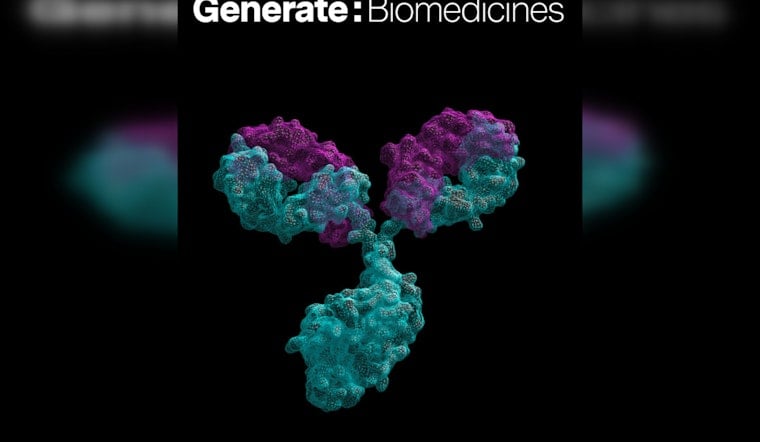
Somerville-based Generate Biomedicines is heading for Wall Street, looking to pull in roughly $425 million in an initial public offering as it leans hard into the hype around AI-designed drugs. The Flagship-founded biotech is pitching 25 million shares at $15 to $17 apiece, a range that would peg its valuation near $2.2 billion and help fund a late-stage push for its lead antibody.
According to the company’s registration statement filed with the U.S. Securities and Exchange Commission, Generate plans to sell 25 million shares at $15 to $17 each. If underwriters exercise their option in full, the company says the offering could bring in up to $425 million in gross proceeds. The filing lays out a familiar biotech money map: cash will go toward advancing GB-0895 through two Phase 3 trials in severe asthma, finishing an ongoing Phase 1b study in COPD, and continuing development of its discovery platform. The registration statement also notes that the platform has already produced multiple computationally engineered proteins that have made it into human trials.
Investment banks and investors say the move comes as the biotech IPO window looks a bit less icy, especially for companies selling an AI angle. Bloomberg reports the deal is expected to price on Feb. 26 and points out that first-time offerings from players such as Aktis Oncology and Veradermics have already lifted sector fundraising this year. That kind of activity has given companies with heavyweight backers and pharma alliances more cover to test public markets.
Pipeline and clinical timeline
Generate says its Generate Platform has already moved three computationally engineered proteins into human studies, led by GB-0895, a long-acting anti-TSLP antibody for severe asthma. The company disclosed that the first patient in one of the Phase 3 trials was dosed on January 26, 2026, and it expects those severe-asthma studies to finish enrollment in late 2027 or the first half of 2028. Early-stage COPD data from GB-0895 are expected this year, and the company is framing those readouts as key tests of whether its AI-driven model really does speed up drug discovery in a meaningful way.
Backing, finances and ownership
As reported by The Boston Globe, Generate raised $273 million in a 2023 Series C round that featured investors such as Amgen and Nvidia’s venture arm, and has brought in roughly $110 million through collaboration agreements with Novartis and Amgen. The company logged a net loss of $223 million in its most recent fiscal year, a step up from $181 million the prior year, underscoring why it is heading to public markets for more cash. Board chair Noubar Afeyan, Flagship’s founder and a co-founder of Moderna, controls about 57% of outstanding shares, while CEO Michael Nally holds around 6.4%, according to the documents.
What investors will watch
The IPO is being led by Goldman Sachs and Morgan Stanley, and Generate aims to list on Nasdaq under the ticker GENB, according to news reports. On the near-term scorecard: how the deal prices, how quickly GB-0895’s Phase 3 asthma trials enroll, and what the early COPD data show. Those are the milestones that could either bolster or rattle the broader thesis that AI-designed protein drugs can outperform traditional discovery. Analysts have also flagged the usual valuation and execution questions hanging over platform-first biotechs as they try to prove that computational design can consistently translate into real-world clinical and commercial wins.





